Skip to content
All tool news

Tool desk · Updated daily

Tool news·Lovable·

Lovable Rebuilds on TanStack Start to Enable Server-Side Rendering.

Lovable now generates server-side rendered apps using TanStack Start, improving discoverability in search engines and AI answer engines.

CW

Create With tool desk

1 source checked · 2 min read · 2 sections

ShareLinkedIn
Lovable Rebuilds on TanStack Start to Enable Server-Side Rendering

Lovable has migrated its entire app generation framework to TanStack Start, enabling server-side rendering for all new projects created after May 13. The change aims to improve default discoverability in search engines like Google and AI-powered answer engines including ChatGPT and Perplexity.

The no-code tool, which lets users build web applications through chat interfaces, previously generated client-side React apps. With the shift to server-side rendering, apps built on Lovable now ship with better SEO capabilities out of the box, a critical feature for builders launching customer-facing products.

Why TanStack Start

In a blog post explaining the technical decision, Lovable cited several factors that led the team to choose TanStack Start over alternatives like Next.js or Remix.

The framework is maintained by an established team with a robust ecosystem, stays within the React world that Lovable already uses, and remains open and independent rather than tied to a specific platform. TanStack Start also supports flexible deployment targets, meaning apps can be deployed anywhere rather than being locked into a single hosting provider.

Perhaps most importantly for an AI-powered code generation tool, TanStack Start offers end-to-end type safety. This gives Lovable's AI clearer guardrails when generating code, reducing the likelihood of type mismatches and runtime errors in the apps it creates.

What Changed for Users

For Lovable users, the migration is largely transparent. New projects automatically use the TanStack Start framework, while existing projects continue to run on the previous architecture unless migrated.

The shift means apps now render initial HTML on the server before sending it to the browser, rather than loading a blank page and then hydrating it with JavaScript. This results in faster perceived load times and content that's immediately visible to search engine crawlers.

The move follows Lovable's recent launch of native Claude integration via MCP Server, part of a broader push to expand the platform's AI capabilities and integration ecosystem. The company has also been investing in visual development tools, including a draw-to-build interface that lets users sketch UI concepts.

Server-side rendering has become table stakes for modern web frameworks, particularly as AI answer engines increasingly rely on crawlable content to generate responses. By making SSR the default, Lovable positions itself to compete with traditional development frameworks while maintaining its chat-based interface.

The technical details of the migration are available in Lovable's engineering blog, which outlines how the team rebuilt its code generation pipeline to support the new architecture.

Sources

1 checked

How we cover tool news: Create With's tool desk drafts these reports with AI from the sources listed above and checks them against those sources before publishing.

Worth passing on?

ShareLinkedIn

Go deeper on Lovable

Related reading, watching and going.

Everything on Lovable →

The briefing

2 Jun 2026

AI Hackathon UK: Build Apps with No Code in 48 Hours

Join Create With's online & in-person AI hackathon June 2026. Learn vibe coding to build apps without technical skills. Supporting Brighton charities. Register now!

Read →

The briefing

19 May 2026

How to Migrate Your App from Lovable to Claude Code in 2025

Step-by-step guide to migrating your Lovable app to Claude Code. Learn how to move from Lovable's managed platform to a stack you own and control.

Read →

The briefing

12 May 2026

The Ultimate Cheap & Scalable Stack for AI Agent Development

Discover the latest AI agent tools and vibe-coded apps from No-Code Poland. Learn about Bubble's AI assistant, Lovable's security standards, and more.

Read →
36 min

Podcast

55. We're Back! Conference Recap, Running Events with AI & Self-Healing Apps

James and Kieran return to the Create With Podcast after their summer break to recap the 2026 Create With Conference in Brighton. They discuss how 550 attendees experienced workshops, a charity hackathon where functional apps were built in 30 minutes, and an innovative conference operating system built entirely with AI. The episode covers the latest developments in AI development tools including Anthropic's Fable model, scheduled tasks in Codex, and self-healing applications using PostHog.

Watch now ↗
29 min

Conference

AI Lets You Build Everything—Here’s Why You Still Never Launch

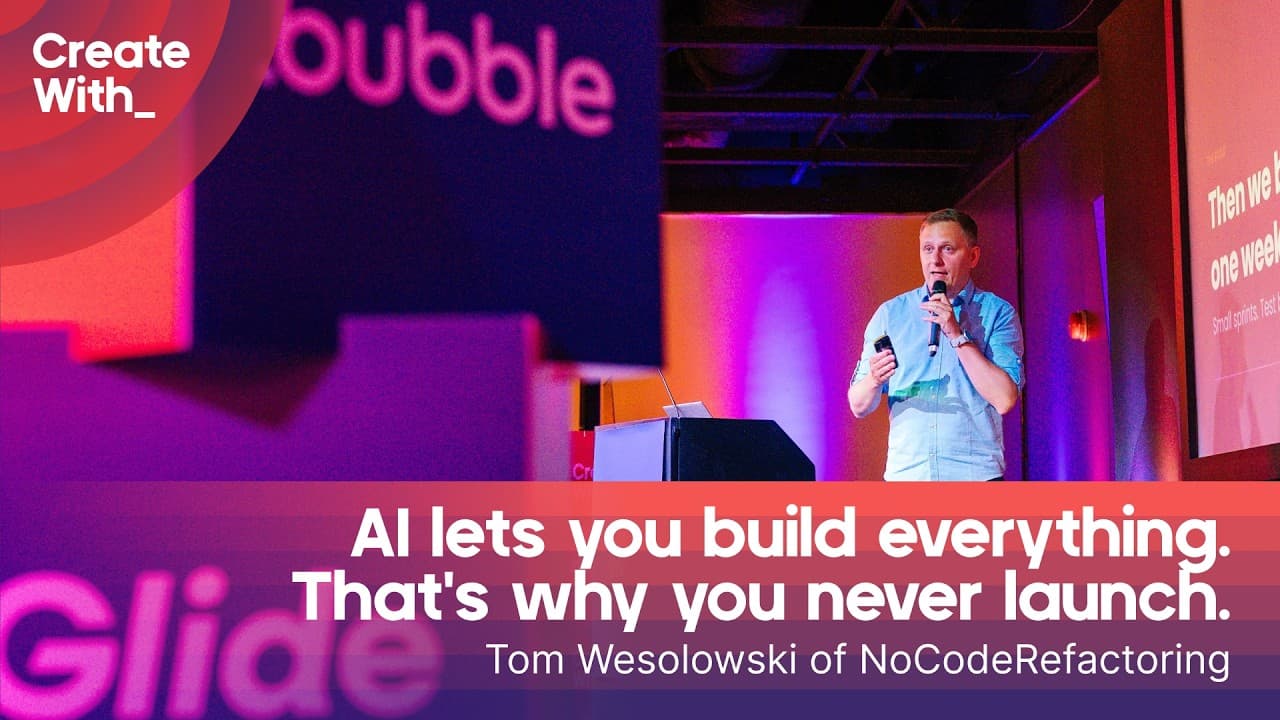
Tom Wesolowski, owner of NoCodeRefactoring.com, delivers a conference talk exposing how AI's ability to build anything has created a new problem: chronic overbuilding that prevents launches. Using a real marketplace project as a case study, he demonstrates how an 80% scope reduction transformed a stalled four-month development into a revenue-generating product launched in two weeks. The talk provides a practical framework for identifying the minimal viable customer loop and postponing everything else until real user demand validates the need.

Watch now ↗
34 min

Podcast

My Daughter Built a Website Business, Claude Design First Look & Going All-In on Cloudflare

James and Kieran discuss practical AI-powered development through real-world examples, including a seven-year-old building a website business with Claude Code voice mode, Anthropic's new Claude Design tool, API security challenges in the AI agent era, and Cloudflare's expanding AI infrastructure offerings. The episode covers hands-on experiences with vibe coding, emerging design tools, and the evolving landscape of AI-assisted development.

Watch now ↗

Latest tool news

What else changed this week.

All tool news
VercelDigest

What Vercel Shipped in Late October

Vercel shipped quicker static deployments, four AI Gateway models, more free domain choices and new CLI controls in late October. The changes cover developers testing sites…

Vercel

Vercel Adds Submit_feedback to Its MCP

submitfeedback is a new Vercel MCP tool that lets agents and harnesses send bug reports, friction reports and feature requests directly to the Vercel team. Feedback can include…

The Create With Briefing

Don't watch forty changelogs. Read one email.

Every Tuesday: the tool changes worth knowing, real business use cases, and what's on near you. Free, unsubscribe any time.



