Skip to content
All tool news

Tool desk · Updated daily

Tool news·Supabase·

Supabase Opens OrioleDB Public Beta on Every Plan.

Supabase opens the OrioleDB public beta on every plan, adding a Postgres storage engine built for update-heavy tables.

CW

Create With tool desk

4 sources checked · 2 min read · 3 sections

ShareLinkedIn
Supabase Opens OrioleDB Public Beta on Every Plan

The OrioleDB public beta is now available on every Supabase plan, giving new projects an alternative Postgres storage engine for tables with frequent updates and deletes. OrioleDB is open source and billed at the same rate as standard Postgres, according to the launch blog post.

You choose OrioleDB when creating a project. Supabase’s LinkedIn announcement describes the main change simply: table rows do not bloat in most cases as data changes.

How the OrioleDB public beta changes storage

Standard Postgres stores rows in a heap. When a row changes, Postgres writes a new version and leaves the old version behind as a dead tuple. It will usually add new entries to every index on that table too, including indexes for columns that did not change.

VACUUM removes those old row versions. Autovacuum runs this process in the background, but it can fall behind on tables receiving frequent updates or deletes. Tables and indexes then occupy more storage than their live data requires, while queries read more pages.

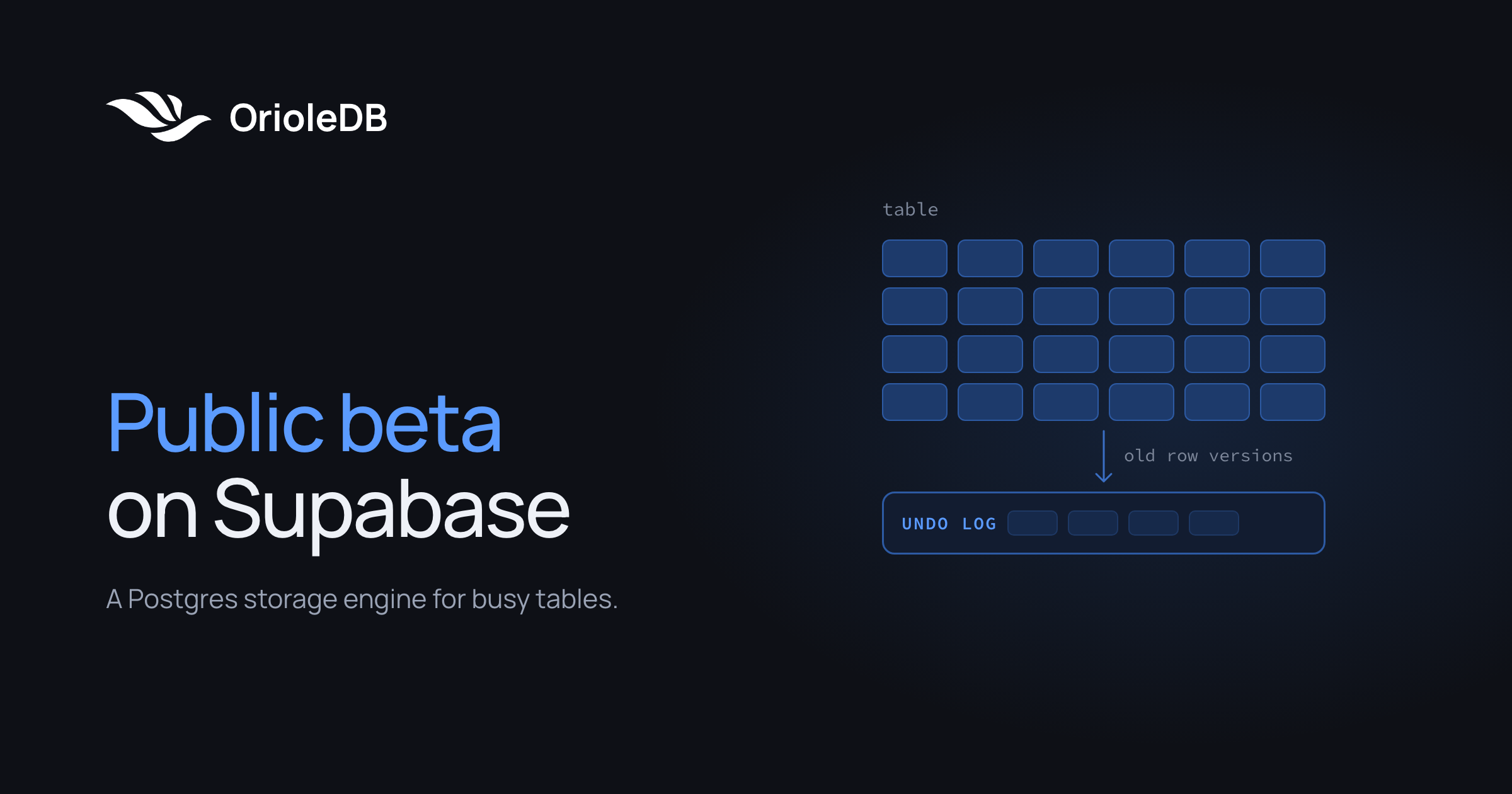
OrioleDB replaces heap storage with an undo log and index-organised tables. This removes VACUUM overhead and 32-bit transaction ID wraparound.

AreaStandard Postgres heapOrioleDB
Row storageHeap tablesIndex-organised tables
UpdatesLeave dead tuplesUse an undo log
MaintenanceRequires VACUUMEliminates VACUUM overhead
Transaction IDsSubject to 32-bit wraparoundEliminates wraparound

What Supabase projects keep

OrioleDB projects support compute and disk resizing, read replicas, Postgres upgrades and scheduled backups. Billing is the same as standard Postgres.

The storage engine is aimed at update-heavy tables. Under the default engine, teams may need to tune autovacuum for individual tables, schedule manual VACUUM runs or rebuild tables with tools such as pg_repack when bloat develops.

Frequently asked questions

What is Supabase OrioleDB public beta?

It is a public beta of an open-source Postgres storage engine designed for update-heavy tables. It replaces heap storage with an undo log and index-organised tables, removing VACUUM overhead and 32-bit transaction ID wraparound.

How is Supabase OrioleDB billed?

OrioleDB is billed at the same rate as standard Postgres. It is available on every Supabase plan and is selected when creating a new project.

Is Supabase OrioleDB ready for production?

No. Supabase describes the release as a public beta and says it is not ready for production yet.

Sources

4 checked

How we cover tool news: Create With's tool desk drafts these reports with AI from the sources listed above and checks them against those sources before publishing.

Worth passing on?

ShareLinkedIn

Go deeper on Supabase

Related reading, watching and going.

Everything on Supabase →

The briefing

13 Oct 2026

Jev - The System One AI That Never Writes a Word, Explained

Deep dive into Jev - TypeSafe's 'System One' model that outputs decisions, not text. Read how it works, real demos (driving), what it's good for and its limits.

Read →

The briefing

30 Sept 2026

Solo Consultant's AI Operating System Built on Markdown

London solo consultant uses an AI personal OS of markdown files—saving ~45% delivery time, boosting revenue 2.4×, and powering 33 community events for ~£250/mo.

Read →

The briefing

15 Sept 2026

€300k Business on 4 Hours/Week with AI — Case Study

Read how a one-man Dutch company scaled to €300k/yr and runs on 4 hours/week by rebuilding ops with Claude Code. Submit your AI case study to be featured.

Read →
36 min

Podcast

55. We're Back! Conference Recap, Running Events with AI & Self-Healing Apps

James and Kieran return to the Create With Podcast after their summer break to recap the 2026 Create With Conference in Brighton. They discuss how 550 attendees experienced workshops, a charity hackathon where functional apps were built in 30 minutes, and an innovative conference operating system built entirely with AI. The episode covers the latest developments in AI development tools including Anthropic's Fable model, scheduled tasks in Codex, and self-healing applications using PostHog.

Watch now ↗
34 min

Podcast

My Daughter Built a Website Business, Claude Design First Look & Going All-In on Cloudflare

James and Kieran discuss practical AI-powered development through real-world examples, including a seven-year-old building a website business with Claude Code voice mode, Anthropic's new Claude Design tool, API security challenges in the AI agent era, and Cloudflare's expanding AI infrastructure offerings. The episode covers hands-on experiences with vibe coding, emerging design tools, and the evolving landscape of AI-assisted development.

Watch now ↗

Podcast

53. Why Your Vibe Code Needs Tests, Ditching SaaS & AI Agents That Work While You Sleep

James and Kieran discuss the practical realities of building AI-powered software, emphasizing the importance of testing in vibe-coded applications, exploring alternatives to traditional SaaS tools, and implementing autonomous AI agents for business operations. The episode covers technical topics like Convex databases, app store bottlenecks from AI-generated submissions, and using OpenClaw as a marketing automation agent.

Watch now ↗

Latest tool news

What else changed this week.

All tool news

The Create With Briefing

Don't watch forty changelogs. Read one email.

Every Tuesday: the tool changes worth knowing, real business use cases, and what's on near you. Free, unsubscribe any time.