 ChatGPT
 Claude
 Supabase
Every business owner wears a dozen hats. Nick Zervoudis wears all of them — and since February 2026 he's had an AI system that helps him keep them straight. We sat down with Nick to find out whether a "personal operating system" built from plain markdown files actually makes a measurable difference to a solo consulting business.
01 / 11
Case study: how a solo consultant uses an AI operating system to multiply his output
The facts. Value from Data AI, a one-person consulting and training business · London, UK · running on AI since February 2026, with a decade of experience working alongside data and AI teams · run cost around £250 per month · in production.
At a glance
- Nick Zervoudis runs a one-person consulting and training business in London, alongside a professional community for data and AI product people. He has spent a decade working alongside data scientists and engineers as a data product manager and data and AI strategy consultant. He is not an engineer or data scientist himself.
- He was already a heavy AI user, on ChatGPT and Claude Projects. What changed was moving past separate chats, repeated uploads and copy-and-paste, to context that maintains itself.
- In February 2026 he rebuilt his working setup around one repo of markdown files, his personal operating system, with a CRM the AI keeps updated, a task list the AI writes, and a daily brief on his phone before he's out of bed.
- Average monthly revenue in the first half of 2026 ran at 2.4 times the 2025 monthly average, from his own figures. He puts part of that down to a young business growing, and part to the capacity the system freed up.
- On one engagement he estimates AI cut his delivery effort by about 45%, and he could turn stakeholder feedback into an updated prototype about two hours later.
- His community is on course for roughly 33 virtual events this year, against 8 in 2025, which he says he could not sustain alongside client work without the automation.
- Nothing is locked to one AI vendor. The core business context is stored in plain markdown, so he switches between Claude Code and Codex whenever he likes.
02 / 11
The business: every job in the company is his
It's just Nick, but he doesn't only sell his time. He consults for big enterprises on where to invest in AI, sometimes going hands-on as the product person, and he trains technical people in commercial and product thinking.
Around the paid work sits a community for data and AI product people, with meetups and about 1,500 people on the mailing list, which makes no money directly but feeds a pipeline whose sales cycles run 6 to 18 months. The virtual side is on course for around 33 events in 2026, against 8 held in 2025.
"My job is to do every job in my company."
The system reduces the manual work across those jobs, while Nick directs the work and reviews important outputs.
03 / 11
Before: curated context that went stale
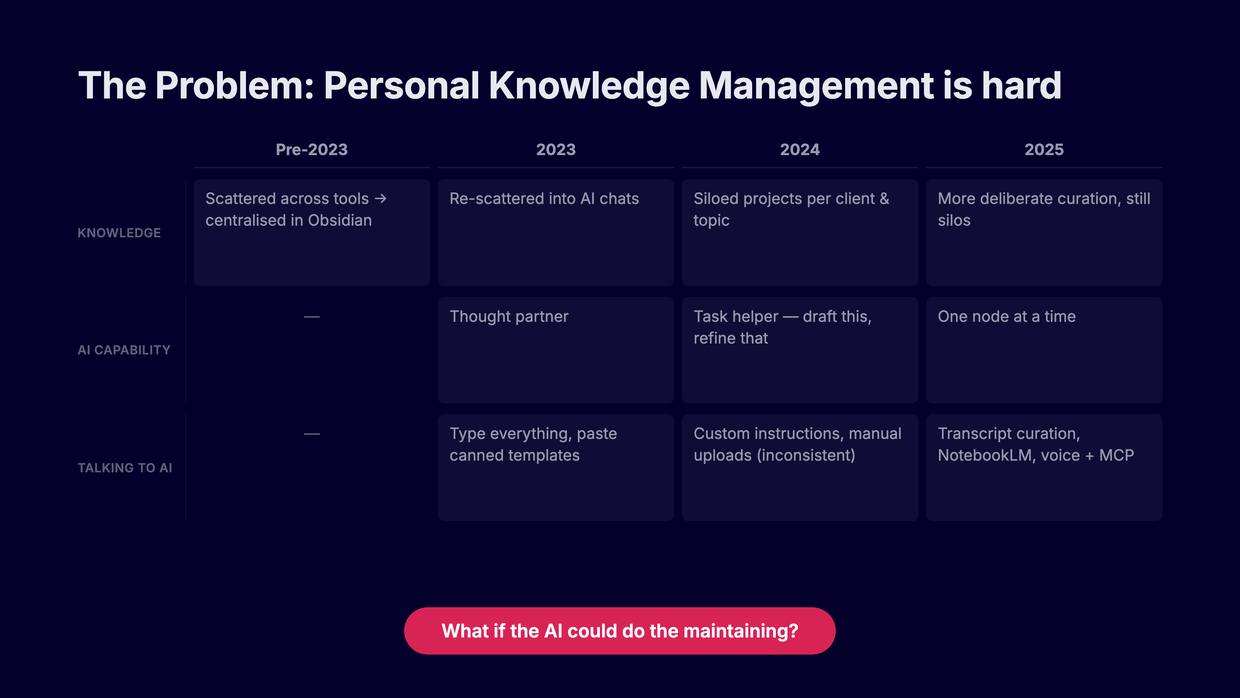
Nick was already a heavy AI user, running everything through ChatGPT and Claude Projects, and it had three problems.
- The context he curated by hand went stale. His LinkedIn project was still writing from two-year-old example posts, because after every good post he was never going to copy it out and re-upload it.
- He fixed outputs instead of instructions. Conversations ran "no, that's not what I meant, do it like that, I also explained this last time", and the same corrections repeated week after week.
- The projects were siloed by design, while his real work is interconnected, course frameworks feed consulting, and consulting produces the stories that improve the course.
The deeper cost sat underneath the repeated corrections. Whole categories of work made no sense to delegate, because fixing the result took longer than doing the job.
04 / 11
What changed: Claude Code arrived and Nick dived in
Claude Code came out and Nick picked it up, in his words, very aggressively, in February 2026. A decade working alongside data scientists and engineers gave him a frame for using a non-deterministic tool: work out the cost of being wrong and design around it.
"It feels crazy that I've not worked with it my whole life now."
05 / 11
What he built: the personal operating system
The core business context lives in one repo of markdown files, viewed through Obsidian and worked through Claude Code or Codex. A global CLAUDE.md file sets the rules, and cascades down into more specific ones.
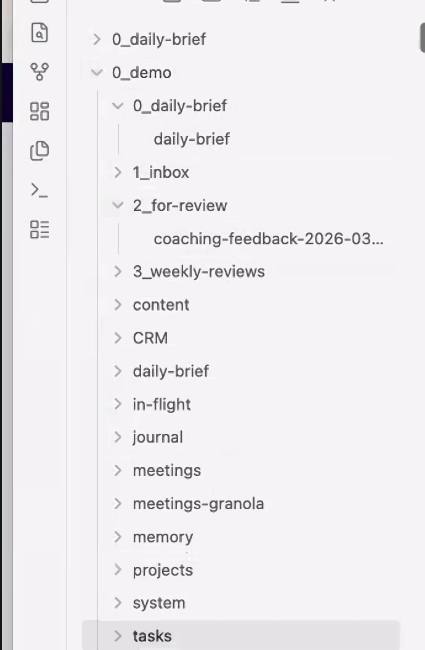
- Context stays fresh on its own. Every call transcript syncs into the repo automatically, and rules tell the AI what to update after each call.
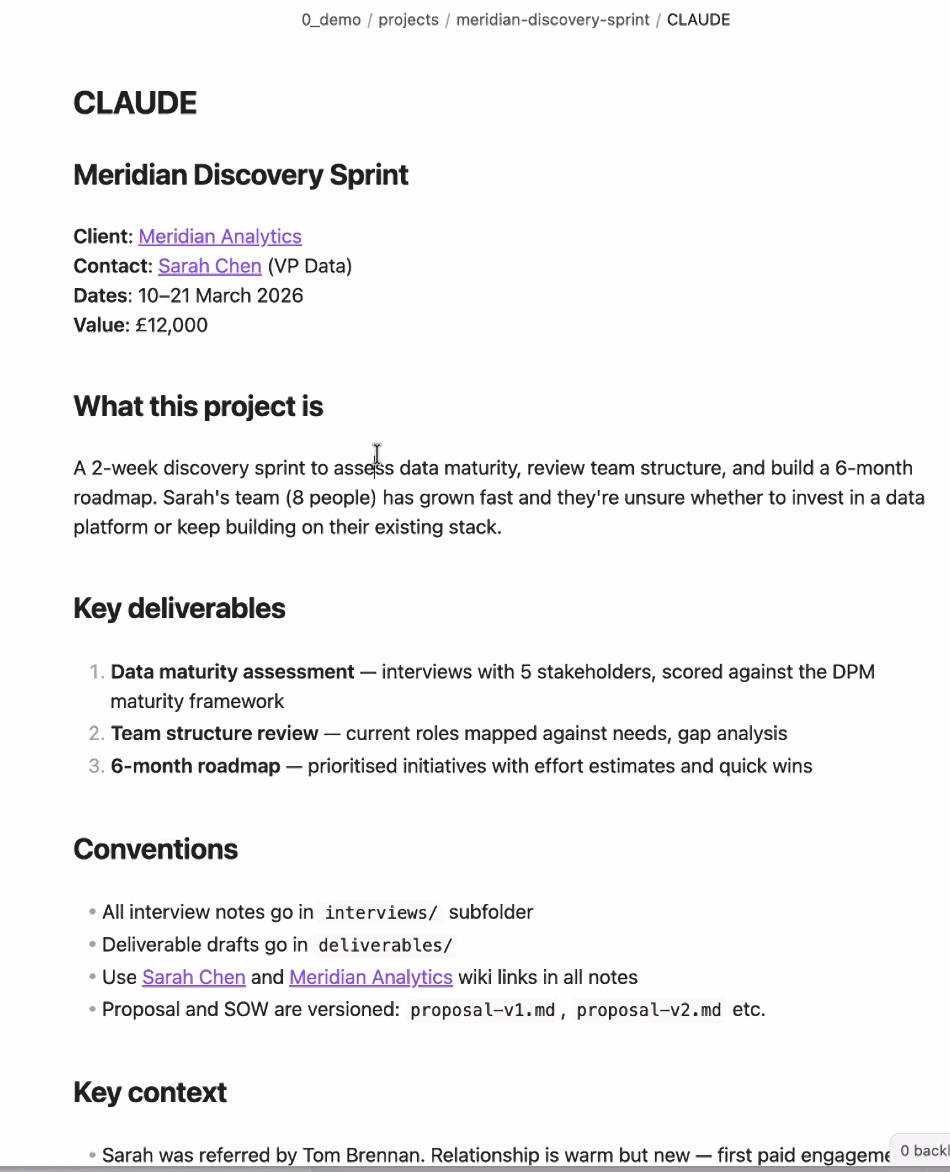
- Each client gets a folder with its own CLAUDE.md, so "I just got off the phone, update the proposal" needs no further explanation, and one client's context can't leak into another's work.
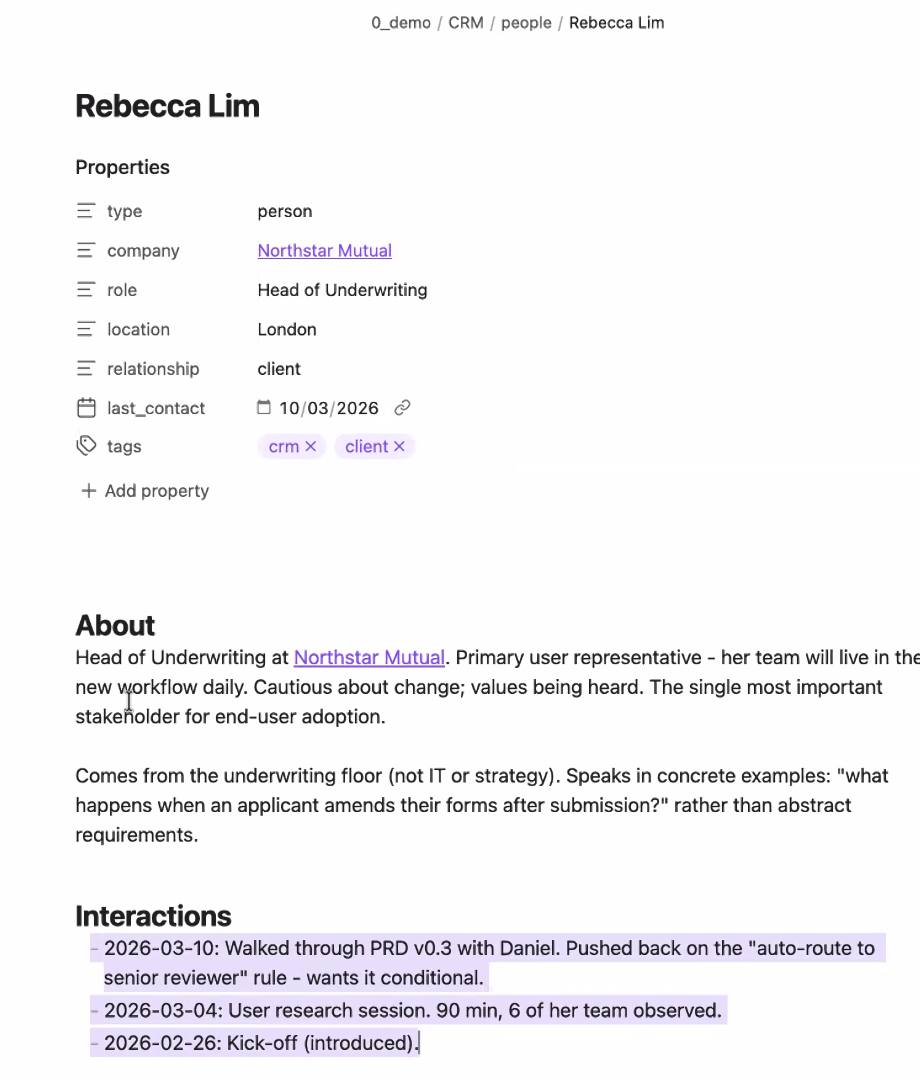
- The CRM writes itself. A markdown note per company, person and opportunity, updated after every call, capturing what each person cares about and the metric they're judged on. When a prospect resurfaces after six months, the next email uses the exact words they used to describe their problem.
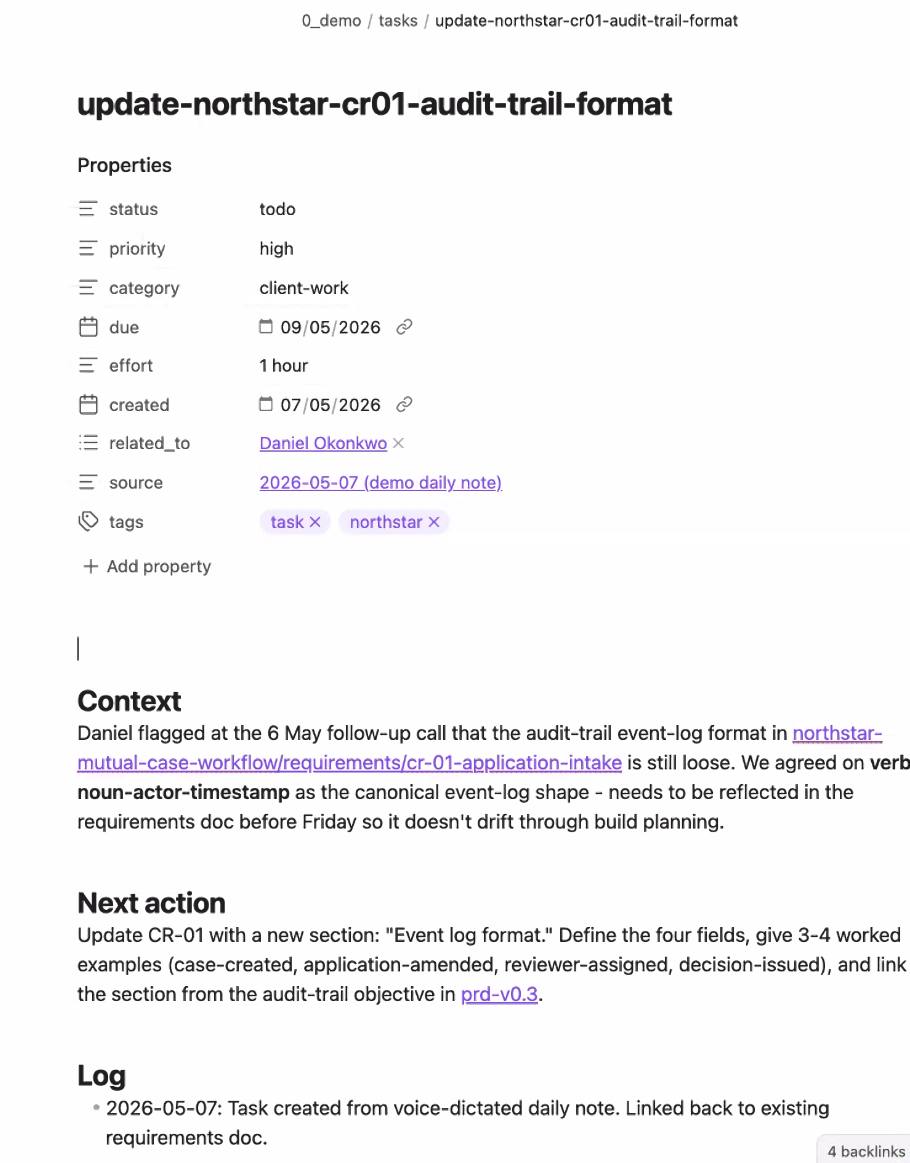
- Tasks write themselves too, with status, priority, due dates and links, under a standing rule that anything the AI can start, it starts. If he promises an introduction on a call, the intro is drafted before he asks.
- He approves anything that leaves the building. Drafted emails land in his Gmail drafts folder, and he reads and presses send.
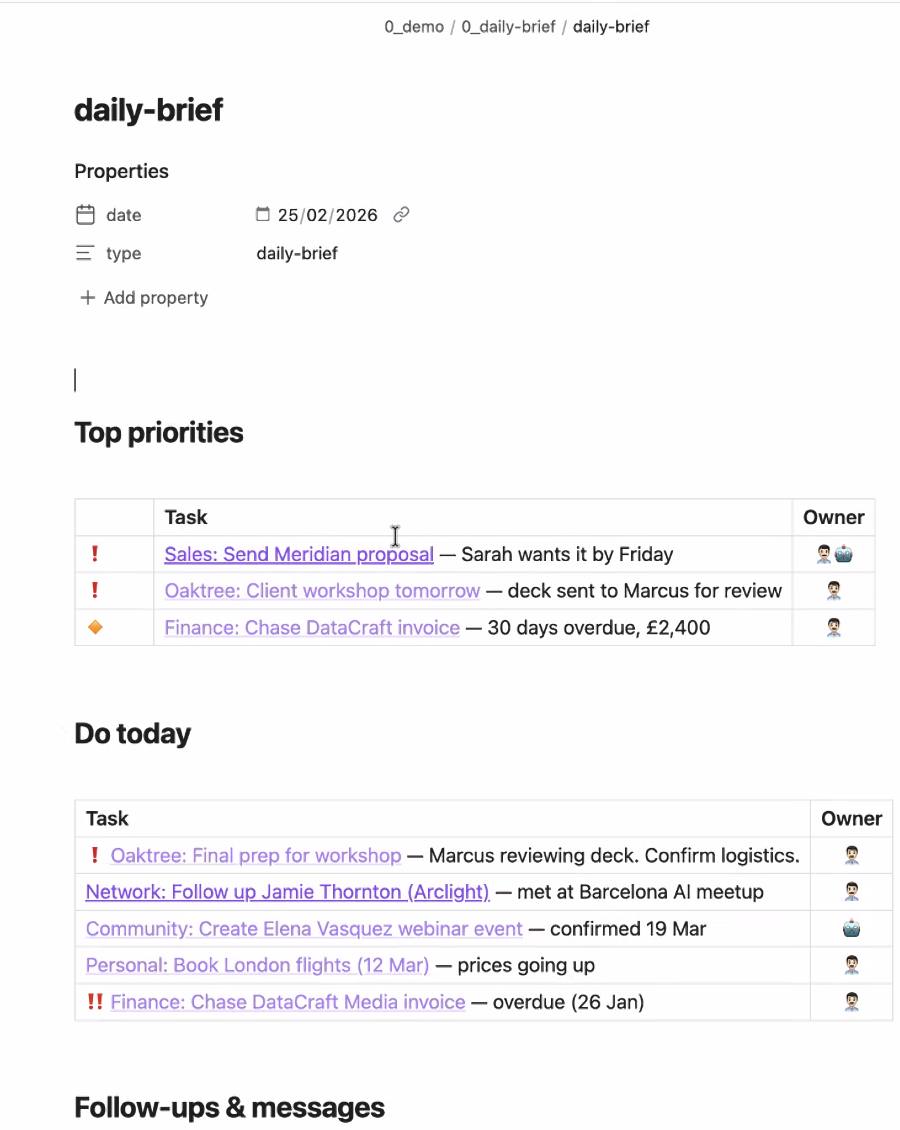
- The day starts with a brief, a Telegram message of top priorities and anything overdue, on his phone before he's out of bed. He has ADHD and a billion tabs open at any moment, he says, and the brief is what pulls him back to the thing that matters.
The stack
Claude Code and Codex interchangeably, Obsidian on the vault, Obsidian Sync plus Git, Granola for automatic transcripts, Wispr Flow for voice input at roughly three times his typing speed, a Telegram bot, and Gmail drafts as the approval layer.
How he looks at it has changed
The first version was Obsidian and nothing else, every note read and edited in the app, which is what the screenshots above show. He still uses Obsidian, just less than he did.
The shift started with one-off requests. He would ask for a plan as an HTML page rather than a wall of text, because it was easier to take in at a glance.
Those one-off pages became permanent. He now has a local web app that starts up with his laptop, with a module for each part of the business, and it is where he reads most of what the system produces.
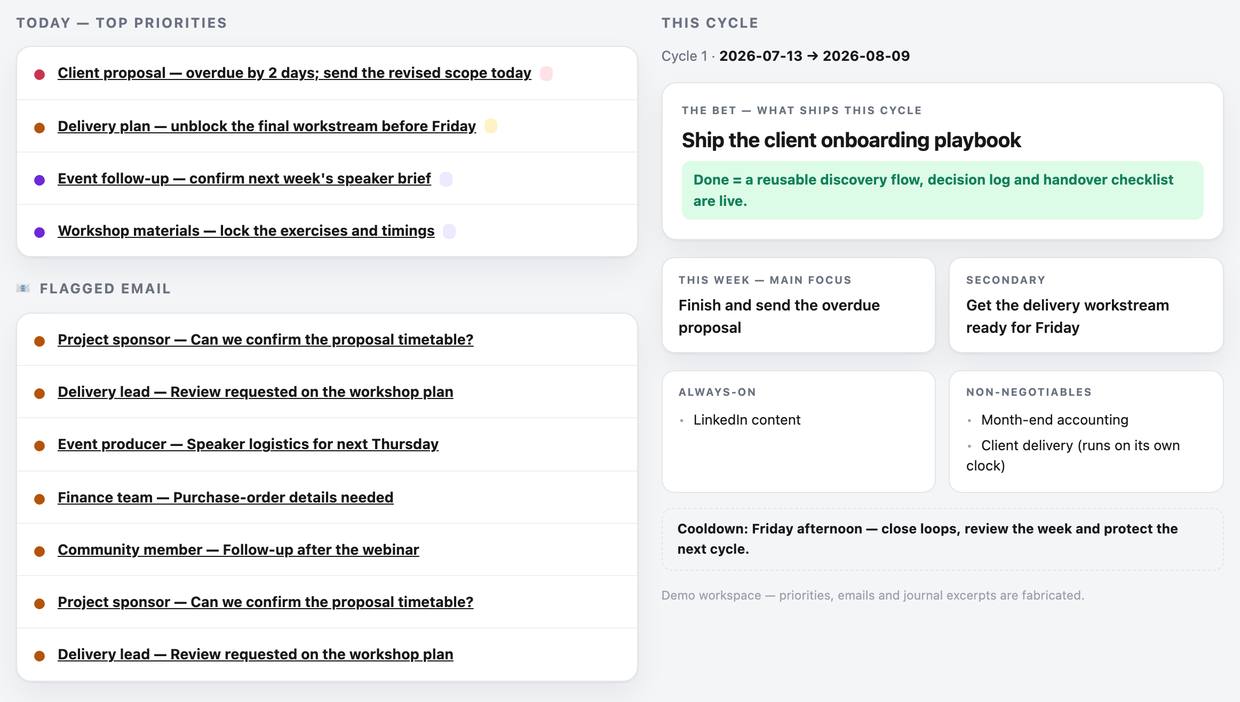
- The dashboard is the daily brief made visual. Top priorities, flagged email, anything overdue, and the objective for the current cycle.
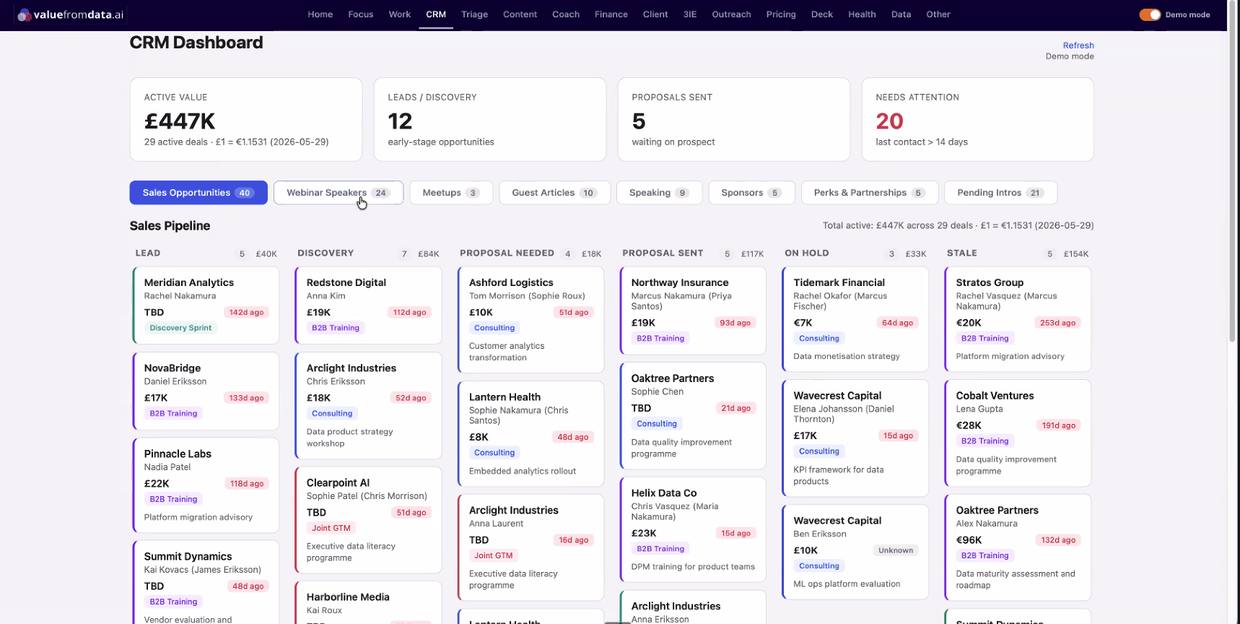
- The CRM module shows the pipeline, what's in flight, what needs a proposal and the total value, all read from the markdown notes underneath.
- The community views are why he didn't buy a CRM. He says he'd have paid for HubSpot if a pipeline was all he needed, but he also tracks webinar guests, meetup sponsors and guest article contributions, so he had the AI build views for those instead.
- A demo mode swaps in randomised data, which took about five minutes to build, and is what let him walk us through all of this without showing a single client's details.
The app reads the same markdown, with a local SQL database for data that doesn't suit notes, like his synced bank transactions. AI-built code powers the dashboard and integrations.
Running a local server sounds like a thing that breaks, and in the first month it did, with the app shutting itself down after periods of inactivity. He fixed the cause rather than restarting it each time, moving it to a Launch Agent that keeps it running.
06 / 11
Effort and result: 2.4 times the monthly revenue, and delivery effort down about 45%
Effort. Hard, months of iteration since February and you have to enjoy it, which he plainly does. There was no big build, just continuous small additions, each kept only if he uses it.
The foundation is markdown and plain-English rules, with AI-built code for the dashboard and integrations. The prerequisite that matters is a habit, treating every annoyance as a broken rule to fix rather than a bad output to correct.
Result. The figures here are Nick's own, sent after the interview, and he labelled the percentages as estimates rather than measurements.
- Average monthly revenue in the first half of 2026 ran at 2.4 times the 2025 monthly average, from his own revenue figures.
- On one engagement he estimates AI cut delivery effort by about 45%. The system held a large amount of stakeholder and project detail he says he would have struggled to sustain otherwise.
- Stakeholder feedback became an updated prototype about two hours later, built in Lovable, which he says has produced referrals and follow-on work.


Where the hours went
His estimates of hands-on time, before and after.
- Updating a training module, including video editing. About 8 hours, down to under 2.
- An event banner and its descriptions. About 40 minutes, down to about 5, which he estimates would save roughly 25 hours a year at the planned event volume.
- Preparing a proposal. About 4 hours, down to about 30 minutes.
Speed matters more to him than the hours. Proposals now go out within zero to two days instead of one to two weeks, which means reaching an opportunity while it is still warm. Events get published sooner too, so guests have more notice.
New work the system created
He puts £200,000 to £300,000 of pipeline down to AI upskilling and operating-model conversations that arose specifically through the personal OS.
Tasks that weren't worth delegating now are, and 99% of his work, his estimate, happens in one interface.
The revenue picture
He is careful about what the 2.4 times figure proves. Some of it is a young business growing, he says, and some reflects the extra capacity and quality he can now deliver.
07 / 11
Reality check: plain files are what make the dependence safe
The strongest objection to any business run this way is dependence, an owner relying on a system they no longer navigate by hand. Nick's answer is that the core business context is plain markdown in Git, readable by any human or model, and he keeps two AI vendors interchangeable so an outage at either can't stop the business.
When he spotted a made-up surname in a reasoning step, he chased it even though the final output was correct, and the rules were rewritten, never invent personal details, always check the CRM, ask when unsure.
"It pays off to treat the system with suspicion."
Fixing the rule rather than the output is how the system gets better, and he is blunt that it has not made the problem go away, "it still makes mistakes".
So he keeps himself in the loop by design. He directs the work, checks the claims that matter and approves anything that goes outside the business.
Your first step. Pick one client, and write one markdown file saying who the people are, what you're doing for them and where things stand. Give it to your AI tool at the start of your next session about them, because that file is the whole system in miniature.
08 / 11
The honest bit: the expertise that transfers is management, not code
The fair challenge is that Nick has spent a decade working alongside data scientists and engineers as a data product manager and data and AI strategy consultant. He is not an engineer or data scientist himself, but he brings experience that a complete beginner may not have.
What blunts it is what the system is made of.
The foundation is folders, markdown notes and rules in plain English, with AI-built application code for the dashboard and integrations.
The habits that make it work are management habits, prioritise ruthlessly, ask for the trade-off, fix the rule not the output. His answer to both kinds of sceptic is the same.
"If you just go, here's a one-sentence prompt, do it for me, it's gonna have a lot of problems. But if you tell yourself, AI sucks, I'll just do all of it by hand, you're gonna be way behind."
09 / 11
What changed for him: the days feel lighter, not shorter
The change Nick rates most highly has no number attached to it.
"I don't necessarily work less. If anything, there are some days that are much more intense than before, but they feel so much lighter. That's partly because I can get more stuff done by just going on a walk and rambling at my phone. It's partly because I don't need to do the most tedious bits of the work anymore, and also because I can constantly challenge myself."
The same maintained context carried his own admin through a messy year, tracking the advisers, research, decisions and open questions involved in relocating, dissolving one company and forming another. He is clear that his advisers still provide the professional advice.
10 / 11
His advice
- Fix the rule, not the output. Every correction should end with a standing instruction that prevents the mistake. This is the habit the whole system compounds on.
- Let adoption be the judge. "Adoption is the real test of whether something is good." Unused modules get changed or killed.
- Match the check to the cost of the mistake. Emails wait in drafts, thumbnails don't. Decide review levels by consequence.
- Keep your system in files someone else could read. Plain markdown made his work durable and portable between vendors.
Case studies are published to help readers understand how other organisations approached a problem. They are not endorsements of a tool or a vendor, and one company's result is not a forecast of yours.
11 / 11
Try it yourself: Nick's starter repo and his talk
Want to try this yourself? Nick has shared his Personal OS GitHub repo, including a free starter prompt you can adapt to your own work.
You can also watch him present the system.
The repo is a starter to adapt rather than a copy of his complete private working system. Find Nick on LinkedIn or subscribe to his newsletter.

Written by
Kieran Ball
Co-founder, Create With

Written by
James Devonport
Co-founder, Create With
The Create With Briefing
Get the next edition first.
Real-life use cases, the tool changes that matter, and the best events near you. Free, every Tuesday, to 8,600+ readers.