Supabase
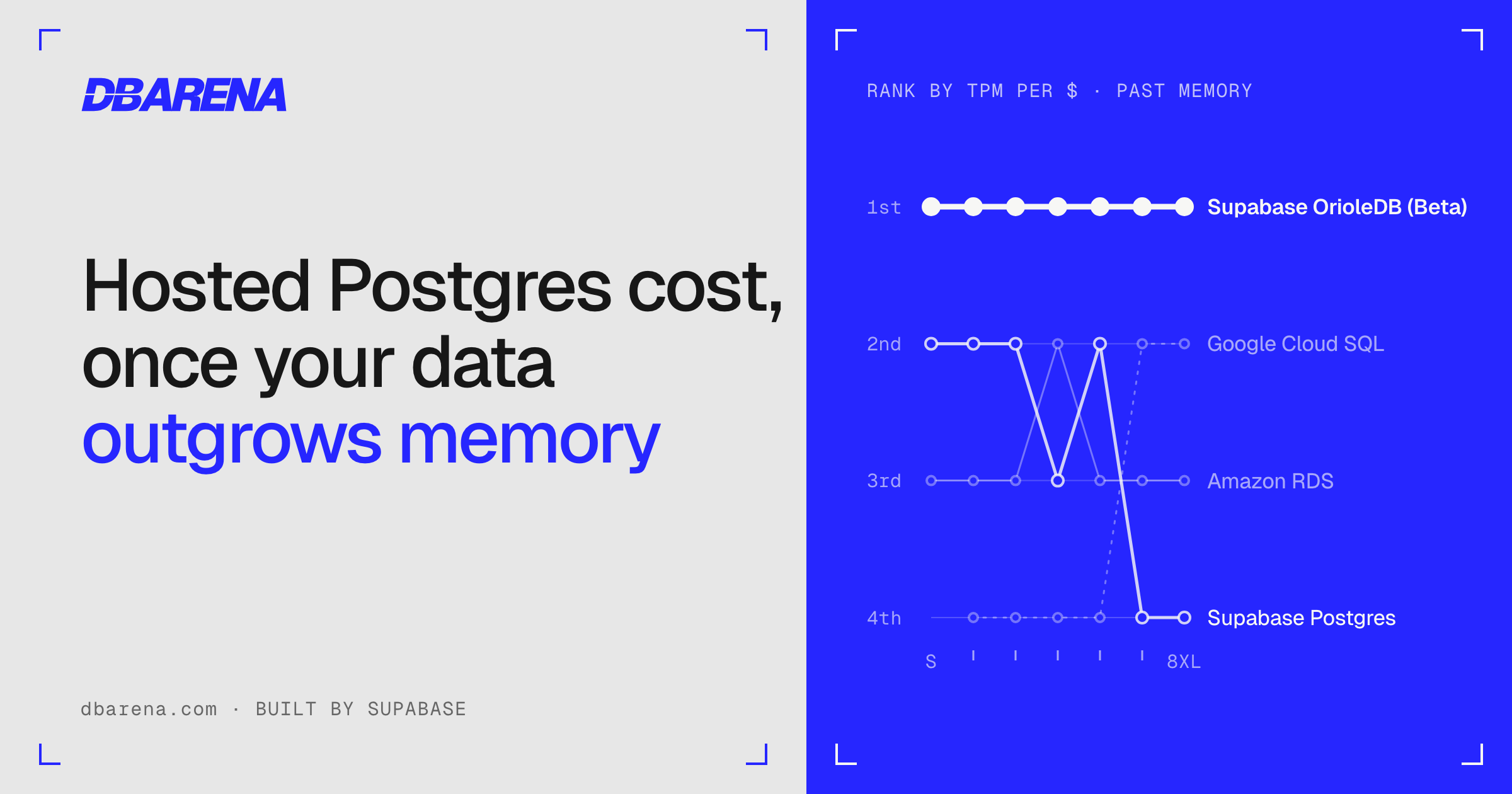
DBArena is a new benchmarking site from Supabase for comparing hosted Postgres providers on throughput, latency and price-performance.
The first results cover Supabase Postgres with default storage, Supabase Postgres with OrioleDB, Amazon RDS for PostgreSQL and Google Cloud SQL for PostgreSQL. According to the Supabase launch blog, each product is tested at up to seven compute sizes using Postgres 17 and the provider’s default configuration.
Supabase sponsors the site. Its methodology is public, while the tools used to run the benchmarks are open source. Every result also includes a raw data file containing the commands, configuration and captured metadata needed to rerun the test.
What DBArena Measures
DBArena matches products by vCPU count and I/O configuration. Clients connect directly over TLS without a connection pooler, which removes another variable from the comparison.
- Compute tiers
- Up to 7
- matched by vCPU count
- Small tier
- 2 vCPU and 2 GiB
- lowest published size
- 8XLarge tier
- 32 vCPU and 128 GiB
- highest published size
- Measurement run
- 60 minutes
- used to calculate average transactions per minute
Each compute tier runs through two scenarios. In the cache-fit test, the data set fits in memory and maintains a buffer cache hit ratio of at least 99%. In the cache-exceeding test, the data set is four times larger than the available RAM, forcing reads from disk. Disk IOPS and throughput are matched across providers.
The results report three measures:
- tpm: average transactions per minute across the 60-minute run.
- tpm/$: transactions per minute normalised by cost.
- p95 latency: the response time at the 95th percentile.
The Supabase results include its default heap storage and the OrioleDB beta, following the release of OrioleDB across every plan.
How DBArena Keeps Tests Reproducible
Most database benchmark results use different instance sizes, configurations or pricing assumptions. DBArena instead runs the same workload at matched vCPU counts and I/O settings. It leaves each provider on its default configuration rather than tuning one database differently from another.
Cost-normalised results sit alongside raw throughput and latency. Builders can therefore compare both how much work an instance completes and what that work costs at each tested tier.
The downloadable commands, configuration and metadata provide a route to check a published result against another environment. They also expose the setup behind each number rather than presenting a standalone performance chart.
Frequently asked questions
What is Supabase DBArena?
DBArena is a site that publishes reproducible benchmarks for hosted Postgres providers. It compares throughput, price-performance and p95 latency using a public methodology.
Which Postgres providers does DBArena compare?
The first release compares Supabase Postgres with default storage, Supabase Postgres with OrioleDB, Amazon RDS for PostgreSQL and Google Cloud SQL for PostgreSQL Enterprise edition. Tests cover up to seven compute tiers using Postgres 17.
Is DBArena free?
The announcement does not list pricing for using DBArena. Its methodology is public, its benchmark tools are open source, and each result includes the raw files needed to rerun the test.
Sources
3 checkedHow we cover tool news: Create With's tool desk drafts these reports with AI from the sources listed above and checks them against those sources before publishing.





 n8n