
Skip to content
All tool news

Tool desk · Updated daily

Tool news·Make·

Make Adds Official Plytix App for Product Workflows.

Make adds an official Plytix app for automating product creation, asset movement, updates and alerts without code.

CW

Create With tool desk

4 sources checked · 2 min read · 3 sections

ShareLinkedIn
Make Adds Official Plytix App for Product Workflows

The Plytix app is now live in Make, connecting product content with the other apps and processes in a builder’s tech stack. It can be used to create products, move assets, trigger updates and send alerts without code.

Plytix announced the official integration in a LinkedIn post. The app is available in the Make library, so builders can include Plytix product data in visual automation scenarios.

The launch gives workflows built around product information a direct connection to the wider stack. Instead of keeping product creation, asset handling, updates and notifications as separate tasks, builders can place them within an automated process.

What the Plytix app can automate

The announcement highlights four types of product-content work:

WorkflowWhat the app can do
Product creationCreate products through an automated workflow
Asset handlingMove product assets between connected parts of the stack
Content updatesTrigger updates based on a workflow
NotificationsSend alerts when the scenario reaches the relevant step

These actions can sit inside workflows centred on product data. A scenario could connect product creation with asset movement, or pair an update with an alert to the relevant team. The exact workflow depends on the apps connected alongside Plytix in Make.

The integration is official, rather than a community-built connector. It is also available from Make’s app library now, so builders do not need to create a custom connection before starting a product-content scenario.

Where the Plytix app fits in Make

Make’s visual builder connects apps through scenarios, with each app handling part of the process. Adding Plytix brings product content into that same model. Builders can use product data as part of a wider operational workflow without writing code.

This release follows a run of Make platform changes covered in What Make Shipped in Mid-September, including updates across its automation workspace.

Frequently asked questions

What is the Plytix app in Make?

The Plytix app is an official integration that connects product content with automated workflows. It is available in the Make app library and does not require code.

What can the Plytix app automate?

It can create products, move assets, trigger updates and send alerts. These actions can be connected to other parts of a product-data workflow.

When is the Plytix app available?

The app is live now in the Make library. Builders can use it when creating automation scenarios around product content.

Sources

4 checked

How we cover tool news: Create With's tool desk drafts these reports with AI from the sources listed above and checks them against those sources before publishing.
Worth passing on?

ShareLinkedIn

Go deeper on Make

Related reading, watching and going.

Everything on Make

The briefing

25 Aug 2026

Claude Code + Figma Console MCP: Side-by-Side Flow

How Claude Code + open-source Figma Console MCP creates a side-by-side design flow that draws straight into your Figma file—no credits or rate limits.

Read →

The briefing

7 Jul 2026

Create With 2026: One Hot Day in Brighton — AI Agents

Recap of Create With 2026 in Brighton: 500+ creators, live AI-agent demos, Claude Cowork workshop, 50+ apps shipped, a 45-project hackathon and community magic.

Read →

The briefing

3 Feb 2026

Vibe Coding vs Automation Platforms: K2.5 & AI Agents

Moonshot's K2.5 rivals GPT-5 at 10x lower cost. AI agents build their own Reddit. Is vibe coding replacing Zapier? Explore the shift from automation to agentic workflows.

Read →
35 min

Conference

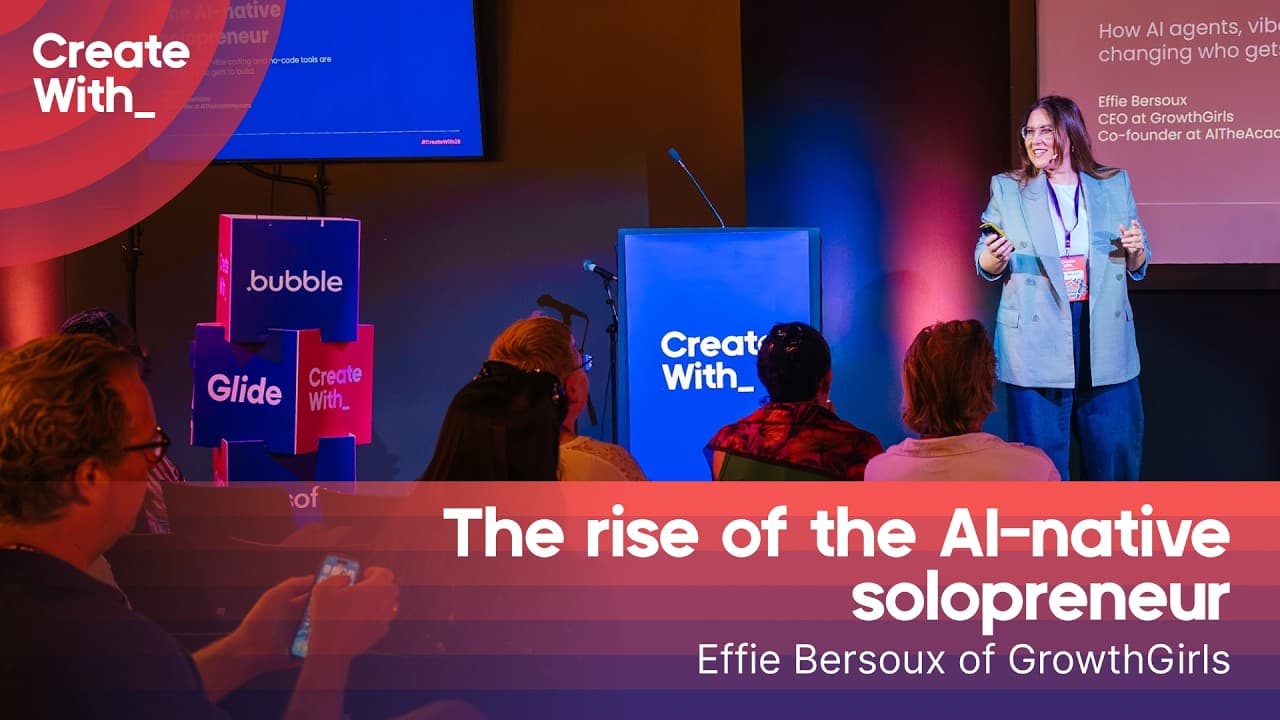
The AI-Native Solopreneur: Build Without a Technical Co-Founder

Effie Bersoux presents a paradigm shift in entrepreneurship where AI enables solo founders to build, validate, and scale businesses without technical co-founders or significant capital. Drawing from Growth Girls' experience building 40+ companies in one year and going from a £4m exit (7 years) to a £40m acquisition target (1 year), she demonstrates how AI breaks the traditional capital-talent-traction loop that disadvantages undercapitalized founders. The talk provides concrete frameworks for AI-native operating models, automation decision-making, and rapid idea-to-market validation.

Watch now ↗
41 min

Meetup

The Mindset Shift That's Creating AI Native Companies

Former HMRC Deputy IT Director Ashraf Murtada shares a framework for understanding AI maturity through three levels: AI Assistance (demanding specific outputs), AI Agents (autonomous systems like Team Brain that join meetings and generate documentation), and AI Coding (building complete applications in hours instead of months). The presentation includes live demos of games, internal tools, and SaaS products built rapidly with AI, arguing that software development is becoming commoditized and traditional MVP timelines are collapsing from 6 months to 6 weeks.

Watch now ↗
28 min

Podcast

51. Running OpenClaw on a $5 server... is it ready for prime time?

James and Kieran from Create With explore the practical applications of Claude Code and OpenClaw in early 2025, demonstrating real-world deployments including running AI agents on budget servers, replacing traditional automation tools with AI-powered workflows, and showcasing Bubble's new in-app payment features. The discussion covers hands-on experiences with deploying production websites, managing email campaigns with AI, and building personal AI operating systems.

Watch now ↗

Latest tool news

What else changed this week.

All tool news
n8nDigest

What n8n Shipped for Recruitment Teams

n8n shipped a new integration aimed at recruitment workflows. This update is for teams that want to move candidate data and status changes into the rest of their stack without…

NotionDigest

What Notion Shipped in Late September

Notion's late September updates cover the unglamorous and the ambitious in equal measure: a desktop bug fix, three new AI models for agents, the first step in rebuilding Notion…

Vercel

Vercel Adds WebMCP Support to Mcp-Handler

WebMCP support is now available experimentally in Vercel’s mcp-handler package. It lets developers expose existing MCP tools to in-browser agents by adding a single script tag to…

VercelDigest

What Vercel Shipped in Mid-September

Eight changes landed on Vercel this week, split between new voice models on AI Gateway and speed improvements to builds and deployments. Builders running voice agents, custom…

The Create With Briefing

Don't watch forty changelogs. Read one email.

Every Tuesday: the tool changes worth knowing, real business use cases, and what's on near you. Free, unsubscribe any time.