 Supabase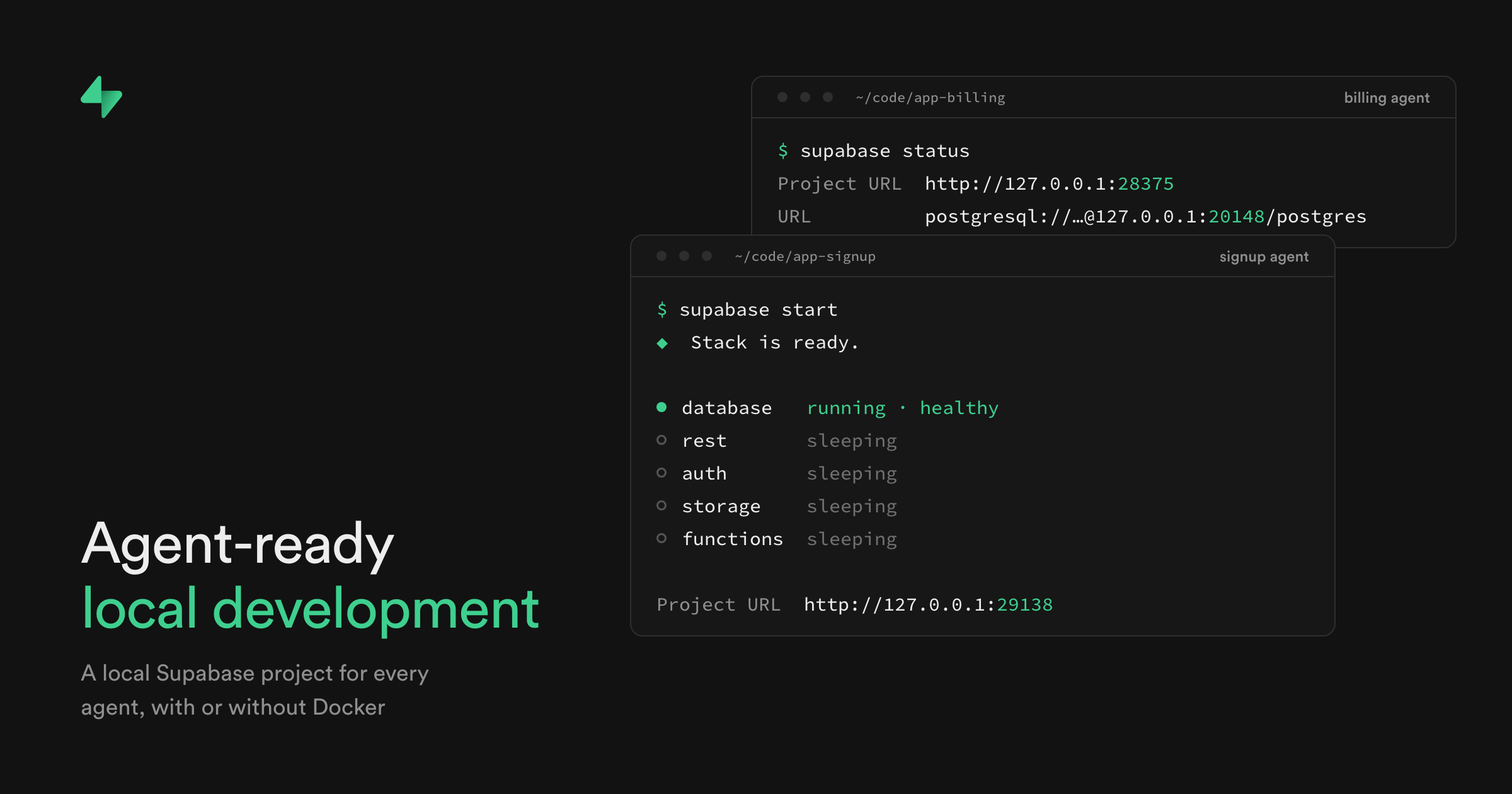
Supabase’s local project per agent setup runs several local projects on one machine, with or without Docker. Each coding agent gets a separate database and backend services, so it can reset, migrate and test without disrupting another agent’s work.
Multiple projects and the native runtime arrive in Supabase CLI v2.119.0 behind an experimental flag. Faster remote branches are already enabled for every project.
Supabase Local Projects Give Each Agent Its Own Backend
The Supabase blog post describes a workflow built around git worktrees. An agent working on billing can run supabase start in one worktree while another agent works on signup in a second.
Each worktree receives its own Postgres database, Storage service, Edge Functions and MCP server. The CLI selects ports automatically and remembers them across restarts. One agent can run supabase db reset without affecting tests running in another worktree.
Agents can read their project URLs and keys from supabase start --output-format json rather than relying on default values. Combined with Supabase Declarative Schemas 2.0 Stops Skipping Database Changes, agents can edit schema files and let the CLI generate the migration.
This removes the need to coordinate local project IDs and ports manually, which was one of the most requested changes to the CLI.
Native Runtime Cuts Start Time and Memory
Supabase has also changed how local services start. Postgres launches first, while services such as Storage remain asleep until their first request. Sleeping services use no CPU or memory, stop again when idle and wake when needed. The --eager option starts everything up front.
With cached artefacts, the native runtime starts a project in 3.9 seconds. That compares with 5.2 seconds for the Docker runtime and 37 seconds for the default engine.
| Measurement | Default engine | Docker runtime | Native runtime |
|---|---|---|---|
| Cached project start | 37 s | 5.2 s | 3.9 s |
| Restart with existing data | 32 s | 2.1 s | 1.4 s |
| First start with empty cache | 93 s | 18 s | 16 s |
Supabase reports that local projects use about a tenth of the memory. Remote branches that take over when a pull request opens are nearly five times faster.
Frequently asked questions
What is a Supabase local project per agent?
It is a separate local Supabase project attached to each git worktree. Every coding agent gets its own Postgres database, Storage, Edge Functions and MCP server, with ports managed by the CLI.
Can Supabase local projects run without Docker?
Yes. CLI v2.119.0 includes a native runtime that runs local projects without Docker, behind an experimental flag. Docker remains an available runtime.
Which Supabase plan includes local projects per agent?
The blog post does not state plan restrictions for the experimental local runtime. Faster remote branches are enabled for every project.
Sources
3 checkedHow we cover tool news: Create With's tool desk drafts these reports with AI from the sources listed above and checks them against those sources before publishing.




 Jotform
 Gemini
 Figma
Figma

 Vercel