Skip to content
All tool news

Tool desk · Updated daily

Tool news·ChatGPT·

ChatGPT Launches Rosalind Academic Plan for US University Labs.

ChatGPT’s Rosalind Academic Plan gives eligible US university labs up to 12 months of sponsored OpenAI tool access.

CW

Create With tool desk

4 sources checked · 2 min read · 3 sections

ShareLinkedIn

The Rosalind Academic Plan gives eligible scientific labs at US universities up to 12 months of sponsored access to OpenAI tools. Access to GPT-Rosalind, a system built for life sciences research, requires separate trusted-access approval.

OpenAI announced the expansion in a LinkedIn post. Applications and eligibility checks are open now.

What the Rosalind Academic Plan includes

GPT-Rosalind is designed to help scientists reason across scientific literature and biological data. Labs can use it while working to understand biology, explore research ideas and decide which experiments to test next.

The sponsored plan and access to GPT-Rosalind have separate conditions:

AccessWhat it coversCondition
OpenAI toolsSponsored access for academic researchEligible labs at US universities
GPT-RosalindLife sciences reasoning across literature and biological dataTrusted-access approval

The sponsored period can last for up to 12 months. The announcement does not name the other OpenAI tools included in the plan.

Researchers keep control of scientific decisions

GPT-Rosalind supports the research process rather than replacing scientific judgement. Researchers remain responsible for evaluating evidence and deciding which ideas deserve further investigation.

Its stated focus covers early research work where literature and biological data need to be considered together. That includes developing an understanding of a biological question, exploring possible directions and choosing what to test.

The launch adds another specialist research product to OpenAI’s work, alongside ChatGPT Launches Astra for Law with Legal Search. GPT-Rosalind is focused on life sciences, while Astra is designed around legal research and search.

Labs can use the application page linked from the announcement to check eligibility and apply. GPT-Rosalind access is not automatic with acceptance onto the sponsored plan because trusted-access approval still applies.

Frequently asked questions

What is the Rosalind Academic Plan in ChatGPT?

The Rosalind Academic Plan provides eligible labs at US universities with sponsored access to OpenAI tools for academic research. GPT-Rosalind is built to help life sciences researchers reason across scientific literature and biological data.

Who can apply for the Rosalind Academic Plan?

Scientific labs at academic institutions in the US can check their eligibility and apply. Access to GPT-Rosalind is also subject to trusted-access approval.

How long does sponsored access last?

Eligible labs can receive up to 12 months of sponsored access. The post does not give pricing after the sponsored period ends.

Sources

4 checked

How we cover tool news: Create With's tool desk drafts these reports with AI from the sources listed above and checks them against those sources before publishing.

Worth passing on?

ShareLinkedIn

Go deeper on ChatGPT

Related reading, watching and going.

Everything on ChatGPT →

The briefing

30 Sept 2026

Solo Consultant's AI Operating System Built on Markdown

London solo consultant uses an AI personal OS of markdown files—saving ~45% delivery time, boosting revenue 2.4×, and powering 33 community events for ~£250/mo.

Read →

The briefing

4 Aug 2026

Cheap Ways to Code with AI Now — Low-Cost Agent Tips

Explore the cheapest ways to run AI coding agents today. Practical tips on models, free bodies, subscriptions, and recent tool shutdowns to code affordably.

Read →

The briefing

16 Jun 2026

How Claude Code Lets One Person Replace SEO Teams Fast

Discover how Claude Code lets one non-technical user automate SEO — from keyword discovery to publishing — replacing SEO teams easily without writing code.

Read →
36 min

Podcast

55. We're Back! Conference Recap, Running Events with AI & Self-Healing Apps

James and Kieran return to the Create With Podcast after their summer break to recap the 2026 Create With Conference in Brighton. They discuss how 550 attendees experienced workshops, a charity hackathon where functional apps were built in 30 minutes, and an innovative conference operating system built entirely with AI. The episode covers the latest developments in AI development tools including Anthropic's Fable model, scheduled tasks in Codex, and self-healing applications using PostHog.

Watch now ↗
31 min

Conference

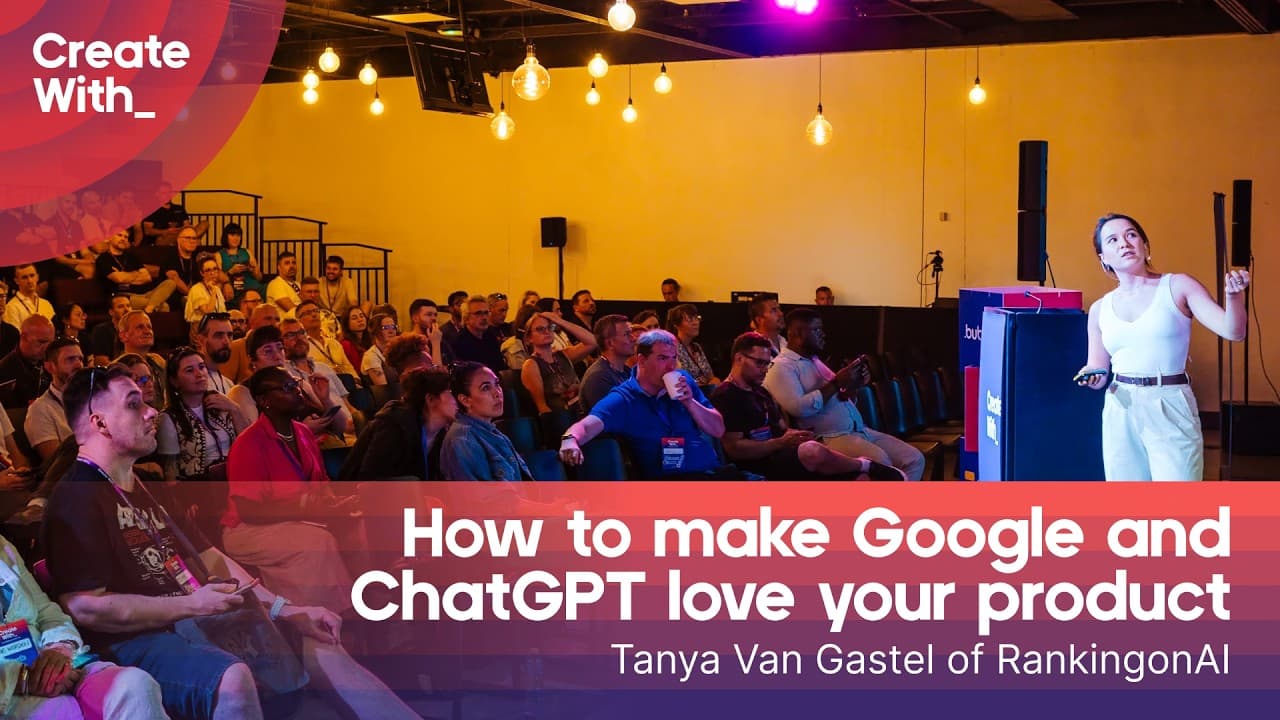
How to Get Your Product Recommended by Google and ChatGPT

Tanya Van Gastel presents the APEX framework for making products discoverable in AI-powered search engines like ChatGPT and Google's AI Overviews. She explains how AI is fundamentally changing product discovery and buyer behavior, then breaks down five critical components: Authority (being cited as a solution), Presence (visibility across search platforms), Expertise (creating high-quality money pages), Endorsements (off-site validation), and Extractability (making content easy for AI to process). The talk emphasizes quality over quantity, with data showing 50% of SaaS SEO revenue comes from fewer than 10 high-performing pages.

Watch now ↗
35 min

Conference

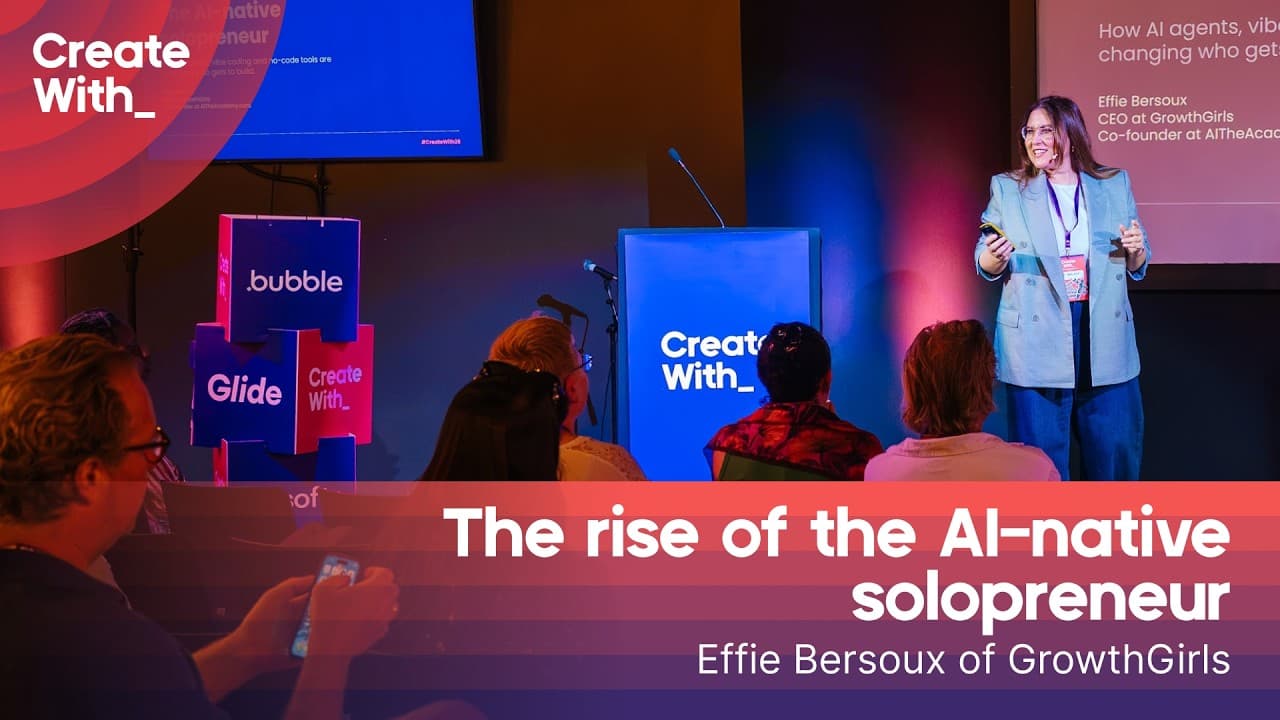
The AI-Native Solopreneur: Build Without a Technical Co-Founder

Effie Bersoux presents a paradigm shift in entrepreneurship where AI enables solo founders to build, validate, and scale businesses without technical co-founders or significant capital. Drawing from Growth Girls' experience building 40+ companies in one year and going from a £4m exit (7 years) to a £40m acquisition target (1 year), she demonstrates how AI breaks the traditional capital-talent-traction loop that disadvantages undercapitalized founders. The talk provides concrete frameworks for AI-native operating models, automation decision-making, and rapid idea-to-market validation.

Watch now ↗

Latest tool news

What else changed this week.

All tool news

The Create With Briefing

Don't watch forty changelogs. Read one email.

Every Tuesday: the tool changes worth knowing, real business use cases, and what's on near you. Free, unsubscribe any time.