 ChatGPT
 Lovable
 Bolt
 Replit
 OpenClaw
 Supabase
 Gemini
01 / 04
On Your Radar
Generative Engine Optimization (GEO) Emerges as Critical SEO Alternative
The digital marketing world is witnessing its biggest shake-up since the dawn of search engines. The overlap between Google's top 10 results and AI platform citations has plummeted from 70% to under 20%, while AI-referred sessions jumped 527% year-over-year. ChatGPT is now driving 39.9% of referral traffic for some brands, creating an entirely new optimisation paradigm that's forcing marketers to rethink everything they know about visibility. As Bain Company reports, 80% of consumers now use generative AI for 40% of their searches, making GEO the new frontier for brands that want to stay relevant in an AI-first world.
Anthropic leaks a potential Lovable/Bolt/Replt competitor
On Sunday Anthropic leaked some screenshots of a new tool they're launching which looks very similar to every vibe coding tool out there. It looks like they may be coming for the prompt-to-app market. This constantly changing tool landscape is why we recommend learning the principles of building rather than particular tools... you never know when they might be killed off by the next one.
02 / 04
Deep Dive: Hermes - A Simpler Self-Learning OpenClaw
Hermes Agent has been gathering momentum over the past few weeks as a "potential OpenClaw killer".
It's built by Nous Research, the trusted team behind popular open-source models like Hermes 3. It's an AI assistant framework similar to OpenClaw that promises something most current agents can't deliver: genuine skill development over time.
It also has a simpler architecture making it less prone to breaking than OpenClaw.
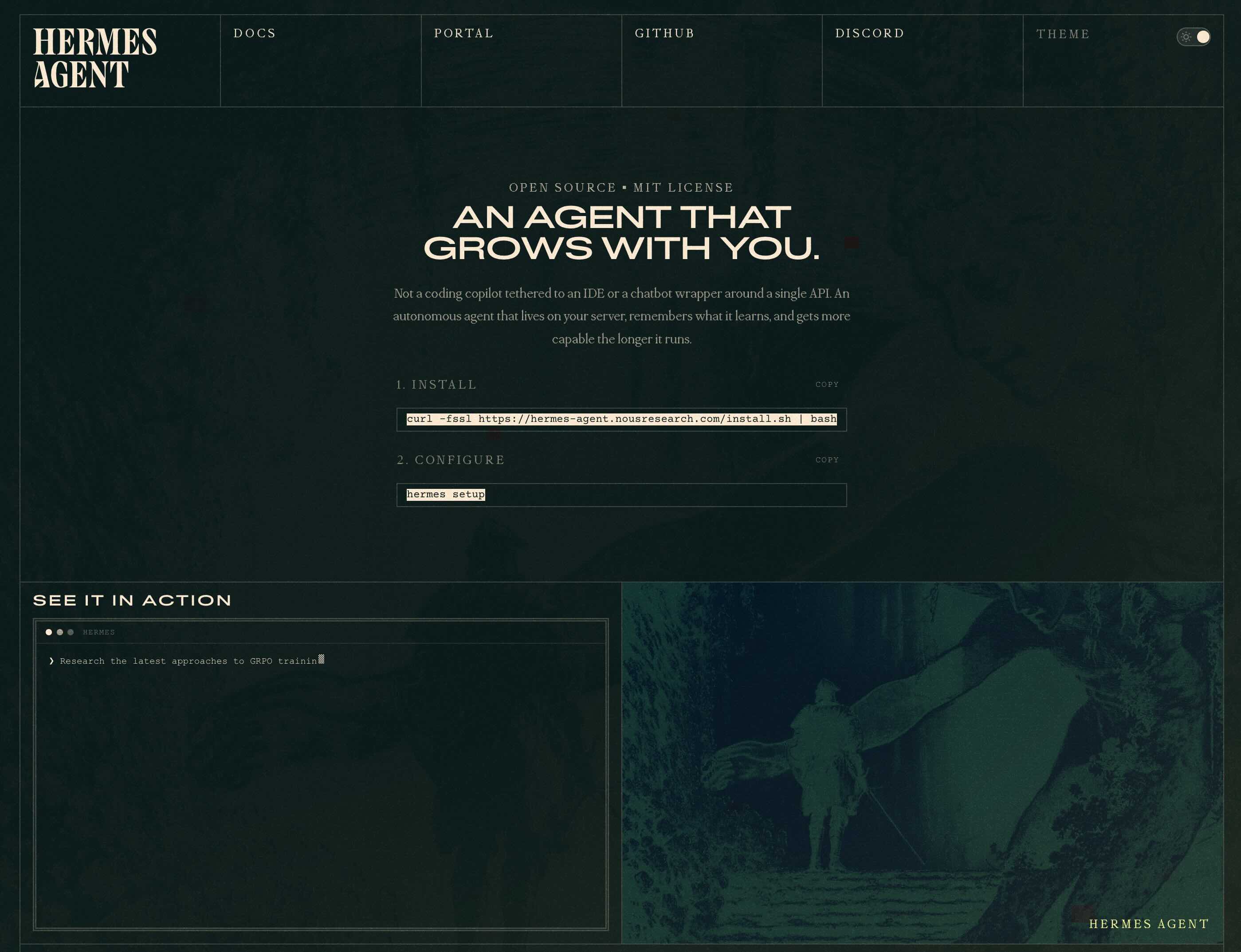
The Self-Learning Agent
Here's where Hermes sets itself apart. While existing frameworks like OpenClaw rely on manually updated, static skills, Hermes implements a learning loop that creates and improves its own capabilities based on experience.
This is genuinely pretty cool. The system visibly builds new skills on the fly, adapting to your specific workflows and preferences. It's the difference between having a tool that executes pre-programmed functions and one that genuinely evolves with use.
As the agent uses a particular skill, it learns from the interaction, creates new skills based on its own experience, and actively refines its capabilities for future use. The more you interact with the agent, the more independent skills it builds for itself to help you out.
The technical foundation is solid too. You can power it with frontier models via OpenRouter or run it entirely locally on your own hardware, using models like Google's Gemma 4.
The Memory Advantage
Another thing that sets Hermes apart is its approach to memory and user modelling. The system uses "Honcho," a dialectic user modelling system that builds deep, evolving understanding of your patterns and preferences.
This goes far beyond simple conversation history. Hermes develops a persistent model of how you work, what you prioritise, and what outcomes you're seeking. That contextual understanding compounds over time.
Because Hermes was built by Nous Research, a model-training lab, it is uniquely designed to use your daily conversations as raw training data.
Real-World Applications
The use cases emerging from early adopters reveal the system's potential:
- Automated research loops that run continuously, testing and refining workflows
- Multi-agent content pipelines where Hermes acts as a "Chief of Staff" coordinating specialised sub-agents (many people are using Hermes as their brain to manage multiple OpenClaw agents)
- Daily briefing systems that autonomously gather, synthesise, and deliver personalised news updates
- Local model improvement cycles that use your interaction data to fine-tune AI models
The Chief of Staff Pattern
Perhaps the most interesting development is what users are calling the "Chief of Staff" architecture. Because Hermes excels at context management and strategic thinking, it's being used as the central brain that delegates specific execution tasks to specialised agents.
This creates a hierarchy where Hermes handles high-level reasoning and coordination, while task-specific agents handle execution. It's a pattern that mirrors how human organisations actually work.
Smart users are also implementing model switching strategies - routing complex reasoning to frontier models while handling routine tasks with smaller, local models to manage costs and latency.
Migration and Setup Reality
For those already invested in other agent frameworks, Nous Research built a specific migration command that imports existing OpenClaw settings, memories, skills, and API keys with one click. The transition friction is deliberately low.
The setup is similar to OpenClaw, albeit a bit simpler.
We liked this video because it shows the setup process in real-time and includes a few mistakes to learn from!
Although Hermes is inherently more secure than OpenClaw, it's still not recommended to install it directly on your main computer. We recommend using a VPS like Hostinger or Hetzner.
As with OpenClaw, our recommendation is to use Claude Code to help you with the setup process. Just tell it "Help me set up Hermes on a VPS https://hermes-agent.nousresearch.com/" and it will guide you through the process.

It comes with things like Voice Mode working out-of-the-box, and its memory seems to be much more reliable than OpenClaw.
It's also potentially cheaper as the agent can hibernate when not being used.
Overall, even if you haven't tried OpenClaw, Hermes is well worth a shot. The self-improving aspect is fun to observe. Try setting up a daily briefing and seeing how it improves it over time.
03 / 04
Video: Claude Cowork deep dive
We were excited to see Create With 2026 speaker JJ Englert on one of our favourite hype-free AI channels How I AI talking about Claude Cowork with Claire Vo!
What's covered:
- Setting up project-based architecture with granular permissions for Gmail, Calendar, Drive, Notion, and Slack
- Building practical AI skills like personalised email writing and multi-perspective review agents
- Creating an "ultra think skill" that automates entire newsletter creation workflows
- Setting up scheduled automations like a 7:30 AM morning briefing that analyses all your communications
- Managing multiple AI agents simultaneously through the orchestration interface
- Real-world applications from house maintenance to wedding planning
JJ will be doing a live workshop on Claude Cowork at the conference on 25th June so grab your ticket today!
04 / 04
Final Thoughts
This one definitely struck a nerve...
Startup founders when they realize building the product was actually the easiest part:
— Andrew Gazdecki (@agazdecki)

Written by
Kieran Ball
Co-founder, Create With

Written by
James Devonport
Co-founder, Create With
The Create With Briefing
Get the next edition first.
Real-life use cases, the tool changes that matter, and the best events near you. Free, every Tuesday, to 8,600+ readers.