Supabase
 Bubble
 Softr
 Claude
 ChatGPT
 OpenClaw
01 / 04
A big announcement...
It's just under a month until Create With Conference 2026! Last week we did another venue visit and also checked out the venue for the after-party. It's going to be pretty special. Grab your conference ticket today.
We're also thrilled to announce that we're partnering with EVOLVE conference, happening the day after Create With at the same venue, to make two fantastic days of tech innovation!
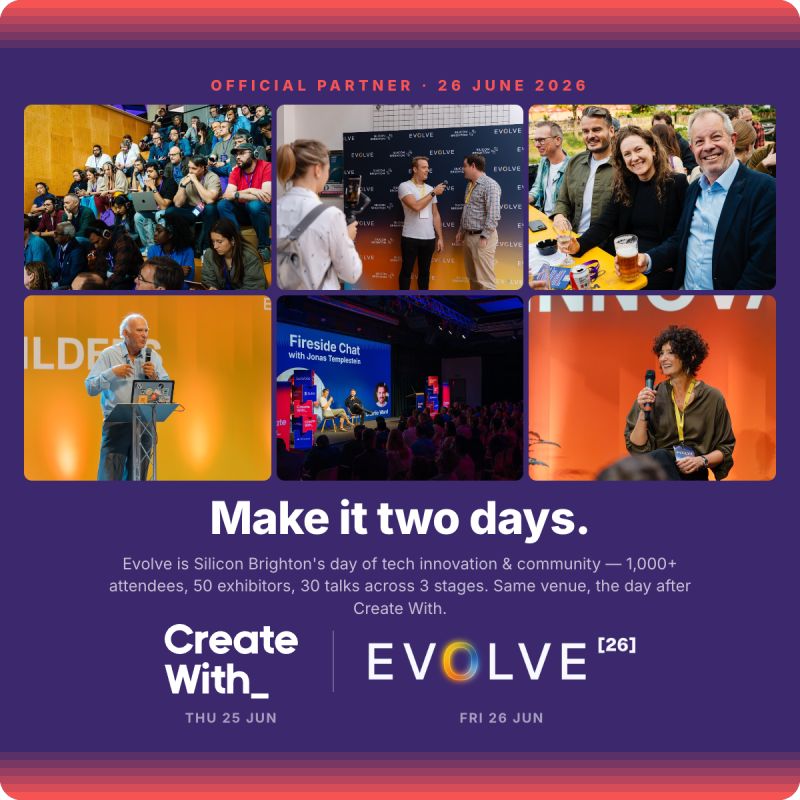
Why not make your trip to Brighton double the fun!
In this week's newsletter we're doing some conference previews, as well as breaking down one of our favourite Claude Code interviews so far.
02 / 04
Conference Previews
Let's be honest - a lot of conferences exist to let the sponsors pitch you their products. Create With is different. Our speakers are community members with nothing to sell but huge amounts of knowledge and experience to share.
Here are some of our faves:
JJ Englert will be keynote speaker at Create With 2026
JJ has been in the no-code and AI scene since day one. He started as a filmmaker, then taught himself no-code after a rough experience hiring developers for his startup.
Since then he's taught thousands of people Bubble and Softr. Today he's community builder at AI consulting company Tenex, leads the AI Builders Community, founded the No-Code Alliance, and hosts the This Week In AI podcast.
JJ stands out for how generously he shares what he knows and how readily he backs other builders. We can't think of a better ambassador for the movement.
Kelly Claus is the official host of CW 2026
Kelly is a true legend of the no-code space. She started her career in education at an opera company, then taught herself software to build them a CRM. She's been hooked ever since.
In 2020 she found Bubble and realised it could handle everything she'd ever wanted to build. Since then she's become one of the leading Bubble developers and educators around, running bootcamps, working with huge clients, and acting as an unofficial developer advocate (we appreciate you Kelly).
Kelly was top-rated speaker at both our previous conferences, so we're delighted to have her hosting this year.
And that's just the beginning...
We've got a brilliant lineup this year. A few highlights:
- George Collier and Tom Wesolowski are both thought-leaders in combining the stability of no-code tools with the power of AI.
- Stephany Oliveros and Andrew Bryce are Claude Code experts who use it in ways you have to see to believe.
- Tanveer M is a lifelong tinkerer with a knack for using tools in unexpected ways. His Openclaw session pulls the whole audience in.
- Now we can all build, the hard part is getting users. Tanya Van Gastel is back after last year's top-rated talk, with more sharp marketing advice on getting your product into Google and ChatGPT.
- Effie Bersoux, CEO at GrowthGirls, will show us how to reach the holy grail of becoming an AI-native solopreneur.
- Oana May tackles the big question of what to actually build now that we can build anything.
03 / 04
Deep Dive: AI as Your Personal Infrastructure
Felix Rieseberg leads some of Claude's most beloved products at Anthropic, but his approach to AI is refreshingly unconventional. He doesn't want AI to move your mouse cursor. He wants it to handle the annoying background work while you focus on creative energy.
Here are favourite takeaways from one of his recent interviews.
This philosophy runs deeper than productivity tips. It represents a fundamental shift in how we can structure our digital lives.
The Anti-To-Do List Principle
Felix's core insight centres on what he calls "going one abstraction layer up." Instead of manually cataloguing furniture for his house move, he told Claude to scan his emails and extract purchase information automatically. The principle: anytime you're doing something tedious, stop and ask how Claude could do it and how you could never do it again.
This approach transforms routine tasks into systematic solutions:
- Email as inventory database: Your purchase receipts become a structured data source
- Context-rich scheduling: Instead of basic calendar summaries, Claude analyses recent Slack conversations and meeting participants to prep you properly
- Promise tracking systems: Automatically monitor commitments made in messages and send timely reminders
The magic happens when you resist the urge to micromanage the process. Felix freely admits he's "never read a single line" of the 3D furniture planner Claude built him. The output matters more than the implementation.
Live Artifacts: Personal Software That Evolves
Claude's live artifacts feature represents something genuinely new. Personalised software that updates itself with your real data. Unlike static tools, these artifacts refresh automatically using connected services like Gmail, Spotify, and Notion.
The technical implementation is surprisingly elegant. Through one-click OAuth connections, you can build dashboards, reports, and interactive tools without managing API keys or worrying about data storage. Want a morning briefing that actually understands your context? Build it once, use it forever.
Felix demonstrated this by creating a personal dashboard in real-time, then casually redesigning it to look like early 2000s software. The creative flexibility is remarkable. You're not constrained by pre-built templates or design systems.
"I want to see software written by Margaret Atwood. I want to see what tools look like that she has made for writing her own books."
This vision extends beyond productivity into creative expression. Non-developers can now build interactive tools that reflect their unique perspectives and workflows.
The $20 Hardware Revolution
Perhaps the most delightful demonstration was Felix's Claude "buddy." A tiny WiFi-enabled device that provides physical feedback when Claude needs approval. For $19, he bought components online and had Claude write all the Bluetooth protocol code.
This isn't just a novelty. It points toward a future where AI can inhabit physical devices throughout our environment. Felix mentioned seeing kids take photos of their drawings and asking Claude to turn them into playable games. The constraints of traditional software are dissolving.
The broader insight: we're living through the "pre-glass pebble" era of AI interfaces. Just as early phones experimented with keyboards, tacos, and lipstick shapes before settling on the touchscreen rectangle, we're still discovering the optimal forms for human-AI interaction.
Why Children Are the Best AI Users
Felix's observation about kids and AI reveals something profound. Children "have never learned what not to ask for." They approach computers expecting them to work like magic.
Adults carry decades of learned helplessness. We've internalised the limitations of previous technology. This creates what Felix calls a "mind prison" that constrains our imagination about what's possible.
His nine-year-old treats Claude as naturally as any other tool, switching between AI assistance and terminal commands without artificial boundaries. This suggests that true AI fluency isn't about learning new skills. It's about unlearning old assumptions.
Model Selection: When Intelligence Actually Matters
Felix's heuristic for choosing between Claude models is telling: reach for Opus when you haven't clearly defined the problem yet. Sonnet 4.6 handles well-scoped tasks beautifully, but Opus excels at the meta-problem of figuring out what you're really trying to solve.
This mirrors how human expertise works. The highest value often comes not from executing solutions, but from reframing problems. When Felix gave Claude a floor plan and asked for measurements, that was a Sonnet task. When he started with "help me design my house," that required Opus-level interpretation.
The practical takeaway: if you find yourself struggling to articulate your request clearly, that's a signal to use the more capable model.
Making Latency Delightful
Anthropic's approach to handling AI response times offers lessons for any async product. The key insight: users will wait for quality if you help them stay comfortable with the asynchronous nature of the work.
Felix advocates actively encouraging users not to watch the AI work. The goal isn't to eliminate waiting, but to redirect human attention toward higher-value creative decisions. While Claude generates your dashboard, you're thinking about visual style or additional data sources to include.
This philosophy extends beyond UX design into AI adoption strategy. The vision isn't humans supervising AI work, but AI handling background complexity while humans focus on creative direction.
Email as Your Personal API
One of Felix's most practical insights involves treating email as a comprehensive personal database. Every purchase, subscription, and service interaction creates structured data that AI can parse and analyse.
This approach transforms email from an overwhelming inbox into a queryable life history. Want to track your clothing purchases? Claude can scan receipts and build you a virtual closet. Moving apartments? Your email contains a complete inventory of everything you've bought.
The principle scales beyond shopping. Meeting confirmations, travel bookings, medical appointments. All become data sources for AI systems that genuinely understand your life context.
Felix is building the future where AI acts as personal infrastructure rather than a fancy search engine. His experiments with hardware, live data, and creative applications point toward AI that genuinely integrates with how humans live and work.
The transformation isn't just technological. It's cognitive. As we unlearn the limitations of previous tools, we can begin imagining computational possibilities that seemed impossible just months ago.
Watch the full interview here.
04 / 04
Final Thoughts
Last week one of the OpenAI founders and coiner of the phrase "vibe coding", Andrej Karpathy, made the surprising announcement he's joining Anthropic.
So someone made an AI video meme of his first day at Anthropic, set in the US-version of The Office. It's good.
Anthropic onboarding day: Michael Scott introducing Karpathy like he just signed Wemby in free agency.
— Siddhartha Saxena (@siddsax)

Written by
Kieran Ball
Co-founder, Create With

Written by
James Devonport
Co-founder, Create With
The Create With Briefing
Get the next edition first.
Real-life use cases, the tool changes that matter, and the best events near you. Free, every Tuesday, to 8,600+ readers.