Vercel
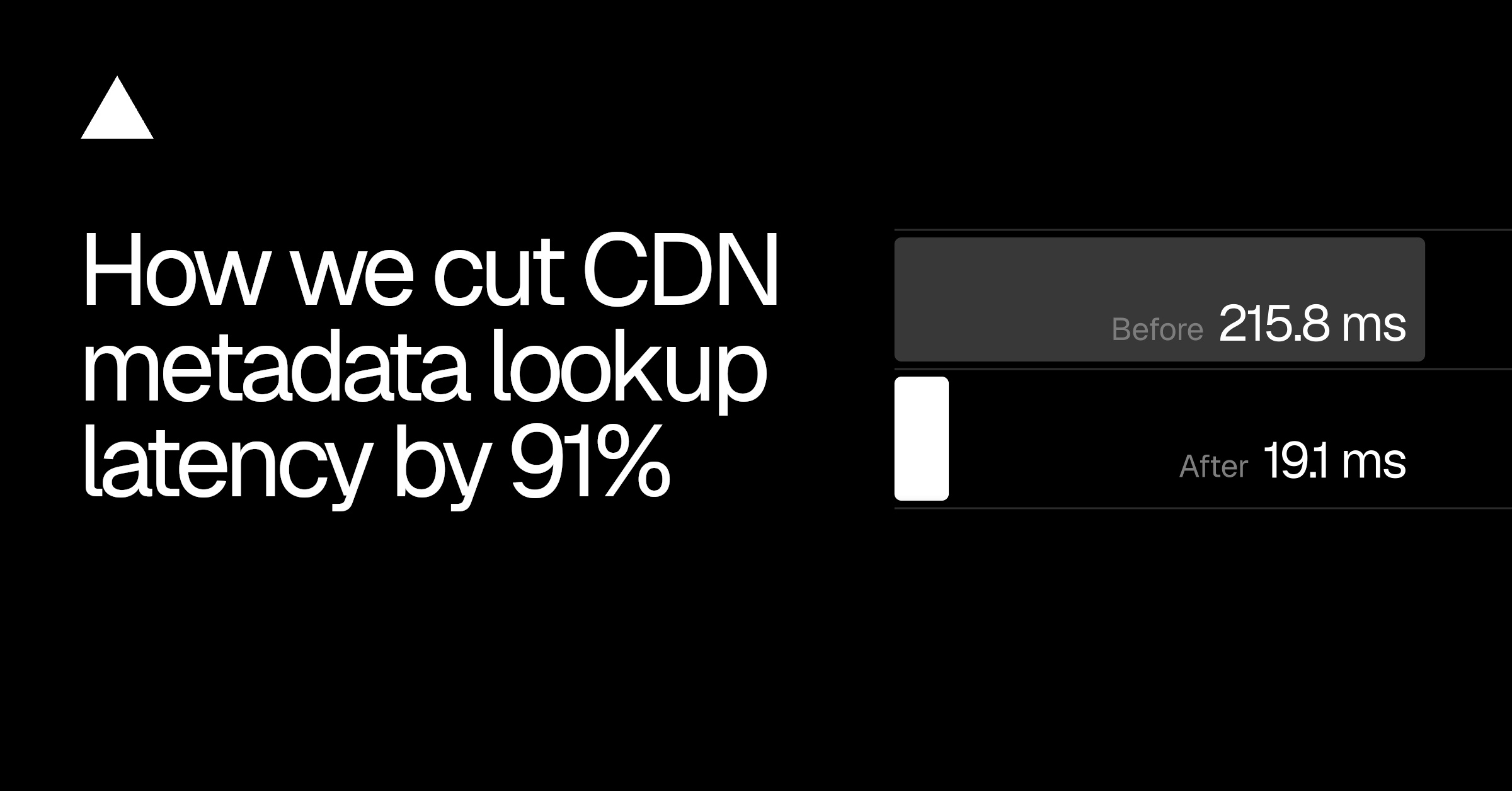
Vercel’s grouped CDN metadata lookups have cut P99 lookup latency by 91%. The change replaces one-path-at-a-time fetching with grouped requests, reducing cache misses for large deployments and improving deployment speed.
According to the engineering blog post, every request to Vercel passes through its CDN. That network executes more than 80 million routing instructions per second on average. Part of this work involves finding metadata that tells the CDN which paths exist and how each one should be served.
- P99 metadata lookup latency
- 91% lower
- after production experiments
- Routing instructions
- Over 80 million per second
- CDN average
- Deployment size
- Hundreds of thousands of paths
- possible on large sites
When the required metadata is not cached, the CDN must fetch it before serving the response. Vercel previously fetched and cached metadata for one path at a time. Each lookup retrieved only the information it needed.
Grouped CDN Metadata Lookups Reduce Cache Misses
Fetching one path at a time created a large number of separate cache entries. A deployment containing hundreds of thousands of paths could have an entry for every path. Each new deployment then introduced fresh metadata, making cache misses a recurring cost for large sites that deployed frequently.
The updated system groups paths together. Fetching metadata in groups means one cache operation can cover more than one path, rather than repeating the process separately for each path. Vercel ran production experiments to find a balance that reduced cache misses without replacing the original problem with excessive fetching.
| CDN metadata process | Previous approach | Updated approach |
|---|---|---|
| Fetching | One path at a time | Paths grouped together |
| Cache entries | One for each path | Shared across grouped paths |
| P99 lookup latency | Baseline | Reduced by 91% |
The resulting configuration cut P99 metadata lookup latency by 91%. It also improved deployment speed, addressing the repeated metadata cost created when large sites published new deployments.
What Builders Need to Change
This is an infrastructure optimisation rather than a new dashboard control or deployment setting. Existing requests still pass through Vercel’s CDN, while the metadata lookup process behind those requests now uses grouped paths.
The work follows another infrastructure performance update that made Vercel Sandbox routing 18x faster worldwide.
Frequently asked questions
What are Vercel grouped CDN metadata lookups?
Grouped CDN metadata lookups fetch information for multiple paths together. Vercel previously fetched and cached this metadata one path at a time.
How do grouped lookups compare with the previous approach?
The previous system could create a separate cache entry for every path in a deployment. Grouping paths reduced recurring cache misses and cut P99 metadata lookup latency by 91% in production experiments.
When are grouped CDN metadata lookups available?
Vercel reported results from production experiments in a blog post dated 10 September 2026. The post does not give a separate rollout date or plan availability.
Sources
3 checkedHow we cover tool news: Create With's tool desk drafts these reports with AI from the sources listed above and checks them against those sources before publishing.



 Supabase