Skip to content
Podcast

52. Your AI Co-Founder: OpenClaw, Manus & the Zero-Person Business

Create With37:09164 views

Summary

In this Create With podcast episode, James and Kieran are joined by Matt Roberts from Happy Operators for an in-depth discussion on using autonomous AI agents in production. The conversation covers practical experiences with OpenClaw, security considerations, comparison with emerging tools like Manus, and the broader shift toward AI-assisted development. They also discuss the VibeCoding Olympics results, Bubble's new AI capabilities, and research on Claude.MD file effectiveness.

What You'll Learn

The Reality of AI Co-Founders: OpenClaw in Production

The theoretical promise of autonomous AI agents building businesses while you sleep has captivated the no-code community for months. But what happens when you actually deploy one in production? Matt Roberts, co-founder of Happy Operators, has been running OpenClaw as a genuine business partner for weeks, and his insights reveal both the transformative potential and pragmatic challenges of treating AI as a co-founder.

Security Through Isolation: The Sandbox Strategy

The most striking aspect of Matt's approach isn't what OpenClaw can do—it's how he's structured access to minimize risk. Rather than connecting his primary accounts, Matt created entirely separate infrastructure:

  • Dedicated Gmail account for the agent
  • Isolated GitHub repository access
  • Separate Vercel deployment credentials
  • No connection to banking or primary business systems

This "new employee" model provides psychological and practical safety. If the agent makes a catastrophic error or gets compromised, the blast radius is contained. Matt describes this as treating OpenClaw like a venture capital investment in a separate entity rather than giving an assistant the keys to your existing business.

The economics reinforce this experimental approach. While Claude Code on the highest tier costs $200/month for power users, OpenClaw runs on a VPS server for under €10 monthly. Using open models like Qwen 2.5 through services like Nvidia's API keeps operational costs near zero, making it viable to run continuously without agonizing over usage limits.

Production Use Cases That Actually Ship

Beyond the security architecture, Matt shared concrete examples of OpenClaw functioning as a productive co-founder:

Content Bloom: An automated Shopify marketing tool that generates and publishes content daily without manual intervention. The agent handles copywriting, scheduling, and deployment—tasks that traditionally require consistent human attention but are easily forgotten in the chaos of running multiple projects.

Asset Management System: Built entirely via Telegram conversations while walking the dog. This exemplifies the mobile-first use case that distinguishes OpenClaw from desktop-bound development tools. The ability to architect and deploy systems during otherwise unproductive time creates genuine leverage.

Daily Reporting and Bug Fixing: OpenClaw autonomously identifies issues in deployed projects and implements fixes, reporting back on what was changed and why. This transforms the agent from a one-time builder into an ongoing maintenance partner.

The key insight: OpenClaw's value isn't unique capabilities—Claude Code can build similar applications. The differentiation is the user experience of asynchronous, mobile-accessible development that continues working when you're not at a computer.

The Update Problem and Self-Hosted Reality

Matt candidly discussed the current limitations. When OpenClaw (nicknamed "Bob" in his setup) needed an update, it couldn't restart itself—highlighting the messy reality of self-hosted agent infrastructure. Unlike SaaS platforms that handle maintenance invisibly, running your own agent means accepting DevOps responsibilities.

Skill installation presents another risk vector. Community-shared "skills" that extend OpenClaw's capabilities could contain malware or unintended behaviors. Matt's approach: treat skill installation with the same caution as hiring a contractor, and do it within the sandboxed environment where consequences are limited.

The Competitive Landscape: Manus, Bubble, and Beyond

The discussion highlighted how rapidly the autonomous agent space is evolving:

Manus: Recently acquired by Meta, this agent demonstrated generating 300 ad creatives with a single toggle—showcasing how platforms are racing to add agentic capabilities to their core products.

Bubble's Buildprints MCP Server: Enables direct editing of Bubble applications from Claude Code, bridging the gap between conversational AI and visual development platforms. This represents Bubble's strategic response to AI-native tools potentially disrupting traditional no-code platforms.

Every major platform recognizes that agents will become table stakes. The question isn't whether tools will have AI capabilities, but which implementation model wins: integrated AI within existing platforms or standalone agents that orchestrate multiple tools.

Surprising Research: Do Claude.MD Files Help or Hurt?

A bombshell study discussed in the episode suggests that Claude.MD project instruction files—widely adopted for providing AI context—may actually degrade model performance rather than improve it. The research indicates models perform better with direct, contextual prompts rather than upfront instruction documents.

This finding challenges conventional wisdom in the AI development community and suggests current best practices may need reevaluation. It underscores how rapidly the field is evolving and how little we actually understand about optimizing AI behavior in production.

The Builder Mindset Matters More Than Technical Skill

Perhaps the most important theme: technical knowledge is becoming less relevant than persistence and creative problem-solving. The VibeCoding Olympics demonstrated this dramatically—1000+ participants, with 100 submitted products from people who had never built software before.

Matt, Kieran, and James agreed: desktop AI tools have lowered the barrier to the point where attitude determines outcomes more than aptitude. The ability to iterate through failures, rephrase prompts, and maintain vision through inevitable technical obstacles now matters more than understanding API architecture or database design.

Practical Takeaways for Builders

Start with isolation: Create separate accounts and infrastructure for your AI agent experiments. This psychological safety enables aggressive experimentation without existential risk.

Focus on boring but valuable tasks: The highest-value applications aren't flashy demos but mundane activities you consistently forget—daily content generation, bug monitoring, routine maintenance.

Economic viability matters: At €10/month, you can afford to let an agent run continuously and fail frequently. This changes the risk calculation compared to tools requiring significant ongoing investment.

Mobile access is transformative: The ability to build and deploy while away from your desk creates genuine leverage, turning previously unproductive time into development sessions.

Security through architecture: Don't rely on trusting AI behavior—design systems where even malicious actions have limited impact.

The autonomous agent era isn't coming—it's here. The builders who treat AI as a co-founder rather than a tool, who architect for failure rather than assuming reliability, and who focus on continuous shipping rather than perfect execution will define what's possible in the zero-person business model.


Key Learnings

1Sandbox security strategy isolates agent risk

Creating dedicated accounts (Gmail, GitHub, Vercel) for OpenClaw completely separates agent access from critical business systems. This architecture allows aggressive experimentation while limiting potential damage from errors or security breaches to a contained environment.

Learn more about OpenClaw

2Economic viability enables continuous operation

Running OpenClaw on a VPS server costs under €10/month using open models like Qwen 2.5 through Nvidia API. This dramatically lower cost compared to premium AI tools makes it economically feasible to let agents run 24/7 without usage anxiety.

Learn more about OpenClaw

3Mobile-first development creates new leverage

Building systems via Telegram while walking or away from a computer transforms previously unproductive time into development sessions. This asynchronous, mobile-accessible workflow distinguishes OpenClaw from desktop-bound tools like Claude Code.

Learn more about OpenClaw

4Buildprints MCP bridges conversational AI and visual platforms

Bubble's new Buildprints MCP server enables direct application editing from Claude Code, allowing developers to use natural language to modify visual no-code applications. This represents platform adaptation to AI-native development workflows.

Learn more about Bubble

5Claude.MD instruction files may degrade performance

Recent research suggests project instruction files widely used for AI context actually worsen model performance compared to direct contextual prompts. This challenges established best practices and indicates optimization strategies need reevaluation.

Learn more about Claude

6Autonomous agents excel at consistent mundane tasks

The highest-value use cases aren't complex systems but boring tasks humans consistently forget—daily content generation, routine bug fixes, scheduled maintenance. Agents provide reliability in these repetitive workflows that humans struggle to maintain.

7Skill installation requires contractor-level caution

Community-shared OpenClaw skills that extend capabilities pose malware and unintended behavior risks. Treat skill installation with the same security scrutiny as hiring an external contractor, and only install within sandboxed environments.

Learn more about OpenClaw

8Builder persistence outweighs technical knowledge

VibeCoding Olympics results (100 shipped products from 1000+ participants, many first-time builders) demonstrate that attitude and iteration matter more than technical expertise. Desktop AI tools have fundamentally lowered barriers where mindset now determines outcomes.

Resources Mentioned

OpenClaw Official Repository

Official OpenClaw documentation, installation guides, and community resources for setting up autonomous AI agents

Visit

Bubble Buildprints MCP Documentation

Learn how Bubble's new MCP server integration enables AI-assisted application development through Claude Code

Visit

Create With YouTube Channel

Weekly podcast episodes and tutorials on building with AI, no-code tools, and automation platforms

Visit

Claude AI Documentation

Official Anthropic documentation for Claude models, including Code mode and best practices for development workflows

Visit

OpenRouter API Platform

Access multiple AI models including Qwen 2.5 through a unified API for cost-effective agent operations

Visit

Happy Operators

Matt Roberts' company specializing in operational automation and AI agent implementation for businesses

Visit

Frequently Asked Questions

How much does it cost to run OpenClaw compared to Claude Code?

OpenClaw runs on a VPS server for under €10 per month, plus minimal API costs when using open models like Qwen 2.5 through services like Nvidia's API. In contrast, power users of Claude Code often pay $200/month for the highest tier. This 20x cost difference makes OpenClaw economically viable for continuous operation and experimentation without usage anxiety.

What security measures should I implement when deploying OpenClaw?

The recommended approach is creating completely isolated infrastructure: dedicated Gmail accounts, separate GitHub repositories, isolated Vercel credentials, and no access to banking or primary business systems. This "sandbox" strategy treats the agent like a new employee in a separate entity, limiting potential damage from errors or security breaches to a contained environment that can be nuked without affecting core business operations.

What are the most valuable real-world use cases for autonomous agents like OpenClaw?

Production deployments show the highest value comes from consistent, mundane tasks humans forget: daily content generation and publishing, routine bug monitoring and fixes, scheduled maintenance, and reporting. Tools like Content Bloom demonstrate automated Shopify marketing running indefinitely without manual intervention. The key isn't complexity but reliability in repetitive workflows where human consistency fails.

Should I use Claude.MD instruction files for my AI projects?

Recent research discussed in the episode suggests Claude.MD project instruction files may actually degrade model performance rather than improve it. Studies indicate models perform better with direct, contextual prompts rather than upfront instruction documents. This challenges current best practices and suggests developers should test their specific use cases rather than assuming instruction files help.

What's the difference between OpenClaw and Claude Code's mobile features?

Claude Code's mobile functionality creates a terminal session tied to your laptop—if you close your laptop, the terminal closes. OpenClaw runs on a separate VPS server accessible via Telegram, enabling truly asynchronous development that continues regardless of your device status. This architectural difference makes OpenClaw better suited for building while mobile, during walks, or other times away from a computer.

More content like this

Never miss a video

Get weekly updates on the best AI tutorials, conference recordings, and community content.

Keep Watching

Related Videos

View all videos
55. We're Back! Conference Recap, Running Events with AI & Self-Healing Apps
Podcast35:53

55. We're Back! Conference Recap, Running Events with AI & Self-Healing Apps

James and Kieran return to the Create With Podcast after their summer break to recap the 2026 Create With Conference in Brighton. They discuss how 550 attendees experienced workshops, a charity hackathon where functional apps were built in 30 minutes, and an innovative conference operating system built entirely with AI. The episode covers the latest developments in AI development tools including Anthropic's Fable model, scheduled tasks in Codex, and self-healing applications using PostHog.

The Biggest AI Opportunities for Non-Technical Builders in 2026
Conference38:09

The Biggest AI Opportunities for Non-Technical Builders in 2026

A closing panel discussion from Create With featuring leaders from Glide, Softr, Bubble, Momen, and TechFoundHer examining how AI and no-code platforms are democratizing software development. The panelists explore what non-technical builders can now create, how AI is transforming service businesses, and where expertise still matters when prototypes become production applications.

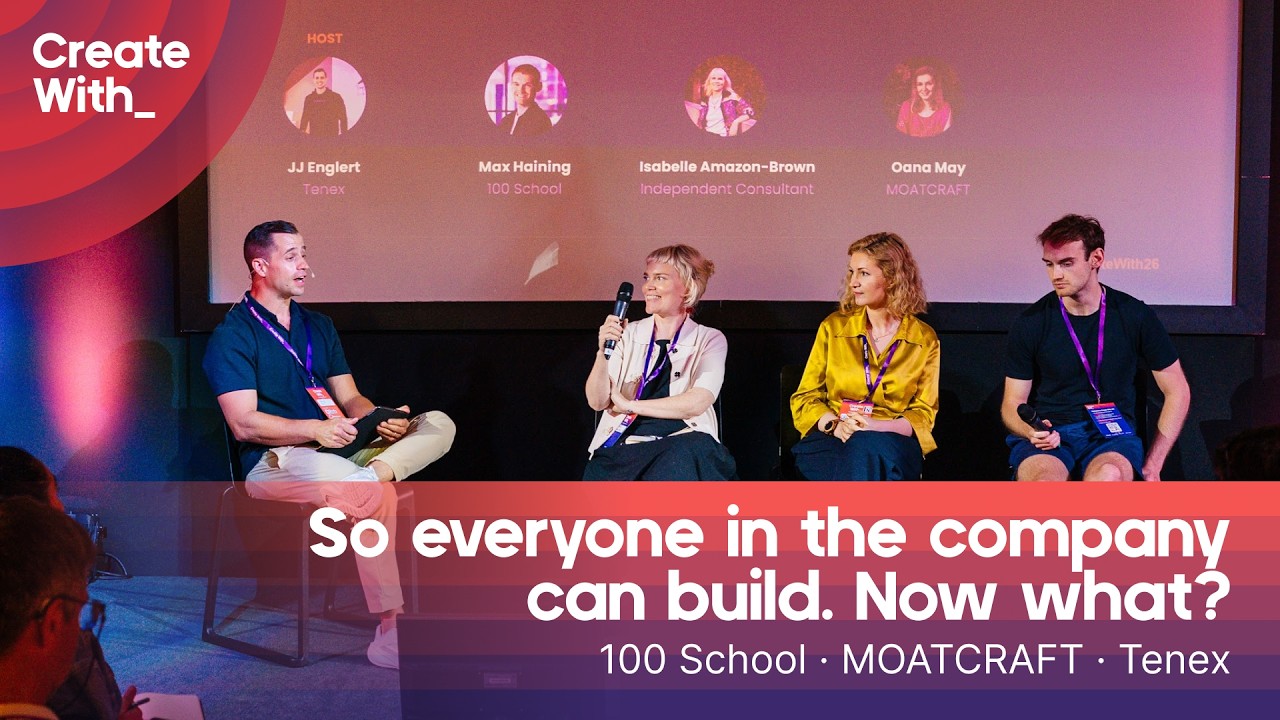
Everyone Can Build with AI. What Should Companies Do Next?
Conference29:07

Everyone Can Build with AI. What Should Companies Do Next?

A leadership panel from Create With conference exploring how companies should approach AI adoption when building tools becomes accessible to everyone. Four experts debate the gap between technical capability and strategic judgment, discussing governance frameworks, safe experimentation, product sense development, and organizational learning pathways for AI transformation.

How to Get Your Product Recommended by Google and ChatGPT
Conference30:12

How to Get Your Product Recommended by Google and ChatGPT

Tanya Van Gastel presents the APEX framework for making products discoverable in AI-powered search engines like ChatGPT and Google's AI Overviews. She explains how AI is fundamentally changing product discovery and buyer behavior, then breaks down five critical components: Authority (being cited as a solution), Presence (visibility across search platforms), Expertise (creating high-quality money pages), Endorsements (off-site validation), and Extractability (making content easy for AI to process). The talk emphasizes quality over quantity, with data showing 50% of SaaS SEO revenue comes from fewer than 10 high-performing pages.

Inside a 60-Skill Claude Code System Running AI Agents in Parallel
Conference35:21

Inside a 60-Skill Claude Code System Running AI Agents in Parallel

Stephany Oliveros, CEO of Lyra AI, presents a production-ready Claude Code architecture for running dozens of AI agents in parallel. She demonstrates a 60-skill system built on progressive disclosure, layered memory, and reusable components that enable coordinated multi-agent workflows without burning through tokens. The talk covers practical folder structures, guardrails, and token economics for building scalable agentic systems.

The AI-Native Solopreneur: Build Without a Technical Co-Founder
Conference34:21

The AI-Native Solopreneur: Build Without a Technical Co-Founder

Effie Bersoux presents a paradigm shift in entrepreneurship where AI enables solo founders to build, validate, and scale businesses without technical co-founders or significant capital. Drawing from Growth Girls' experience building 40+ companies in one year and going from a £4m exit (7 years) to a £40m acquisition target (1 year), she demonstrates how AI breaks the traditional capital-talent-traction loop that disadvantages undercapitalized founders. The talk provides concrete frameworks for AI-native operating models, automation decision-making, and rapid idea-to-market validation.