Skip to content
All tool news

Tool desk · Updated daily

Tool news·Vercel·

Vercel Brings Vercel Traces Search to the Terminal.

Vercel adds vercel traces search for finding and filtering request spans from the CLI, with KQL queries and JSON output.

CW

Create With tool desk

3 sources checked · 2 min read · 3 sections

ShareLinkedIn
Vercel Brings Vercel Traces Search to the Terminal

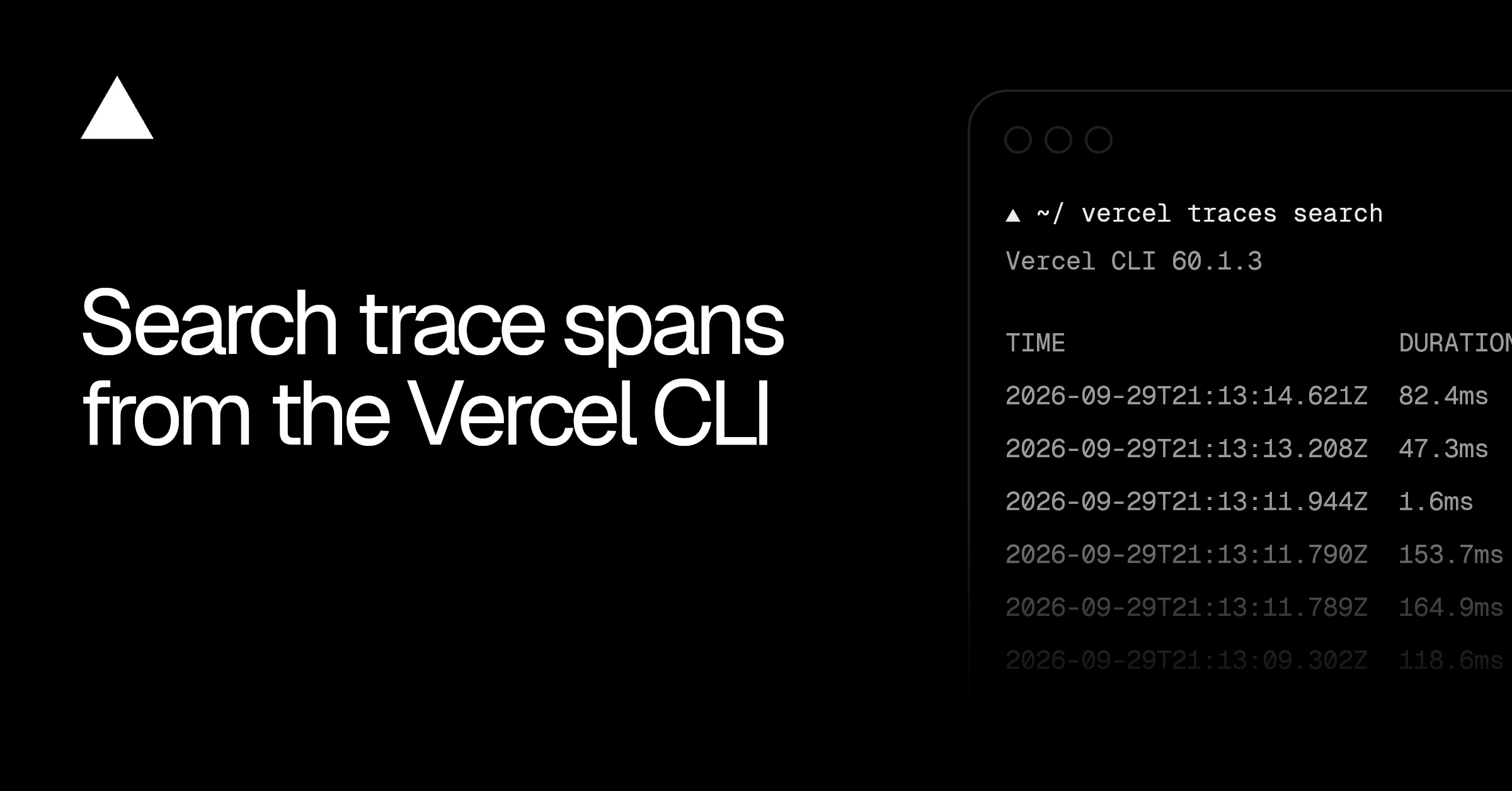
vercel traces search lets builders and coding agents inspect a project’s trace spans from the terminal. Each span covers one step in a request, giving you a way to investigate errors, latency and security-related behaviour without opening the Vercel dashboard.

The new command is available through the Vercel CLI. According to the Vercel changelog, it searches recent spans without requiring a request ID or trace ID first.

How vercel traces search works

Run vercel traces search and the command returns up to 100 spans from the last hour. Results appear newest first.

You can narrow that result set using command-line filters:

FilterWhat it narrows
EnvironmentSpans from a selected environment
Service or span nameA particular service or request step
StatusResults such as error spans
Deployment IDRequests linked to one deployment
Request, trace or span IDA specific request or part of a trace
--since and --untilThe time range searched

For example, combining the error status with --since 1h returns error spans from the previous hour. A trace ID filter returns every span belonging to one trace.

This puts the investigation alongside the rest of a terminal workflow. A builder can move from a failed deployment or reported request problem to its spans without switching to the browser. Coding agents can search the same trace data through a CLI command.

KQL queries and structured output

The command also supports KQL for more advanced searches. Queries can target span duration and attributes, adding finer controls than the standard flags.

Results can be returned as JSON for structured analysis. That gives scripts and coding agents a structured result rather than terminal-formatted text, while the default output remains suited to direct inspection.

The combination of standard filters, KQL and JSON output covers both quick terminal checks and machine-readable investigations. The default one-hour window and 100-span limit also give each search a defined starting point before filters or time controls are added.

Frequently asked questions

What is vercel traces search in Vercel?

It is a Vercel CLI command for searching a project’s trace spans from the terminal. A span represents one step in a request and can help investigate errors, latency and security-related behaviour.

What does vercel traces search return by default?

It returns up to 100 spans from the last hour, ordered newest first. You do not need to find a request ID or trace ID before starting the search.

Which Vercel plan includes vercel traces search?

The changelog does not state which plans include the command. It describes access through the Vercel CLI but gives no pricing or plan details.

Sources

3 checked

How we cover tool news: Create With's tool desk drafts these reports with AI from the sources listed above and checks them against those sources before publishing.

Worth passing on?

ShareLinkedIn

Go deeper on Vercel

Related reading, watching and going.

Everything on Vercel →

The briefing

19 May 2026

How to Migrate Your App from Lovable to Claude Code in 2025

Step-by-step guide to migrating your Lovable app to Claude Code. Learn how to move from Lovable's managed platform to a stack you own and control.

Read →

The briefing

10 Feb 2026

OpenClaw Review: 2 Weeks With This AI Agent

Honest 2-week review of OpenClaw — an autonomous AI agent powered by Claude. We test setup, safety, autonomy, and real value to see if it's worth using.

Read →
34 min

Podcast

My Daughter Built a Website Business, Claude Design First Look & Going All-In on Cloudflare

James and Kieran discuss practical AI-powered development through real-world examples, including a seven-year-old building a website business with Claude Code voice mode, Anthropic's new Claude Design tool, API security challenges in the AI agent era, and Cloudflare's expanding AI infrastructure offerings. The episode covers hands-on experiences with vibe coding, emerging design tools, and the evolving landscape of AI-assisted development.

Watch now ↗

Podcast

53. Why Your Vibe Code Needs Tests, Ditching SaaS & AI Agents That Work While You Sleep

James and Kieran discuss the practical realities of building AI-powered software, emphasizing the importance of testing in vibe-coded applications, exploring alternatives to traditional SaaS tools, and implementing autonomous AI agents for business operations. The episode covers technical topics like Convex databases, app store bottlenecks from AI-generated submissions, and using OpenClaw as a marketing automation agent.

Watch now ↗
38 min

Podcast

52. Your AI Co-Founder: OpenClaw, Manus & the Zero-Person Business

In this Create With podcast episode, James and Kieran are joined by Matt Roberts from Happy Operators for an in-depth discussion on using autonomous AI agents in production. The conversation covers practical experiences with OpenClaw, security considerations, comparison with emerging tools like Manus, and the broader shift toward AI-assisted development. They also discuss the VibeCoding Olympics results, Bubble's new AI capabilities, and research on Claude.MD file effectiveness.

Watch now ↗

Latest tool news

What else changed this week.

All tool news
ChatGPTRoundup

GPT-6 Sol and Luna Roll Out Across ChatGPT

OpenAI shipped two new models this week, and three tools in our directory switched them on within hours of each other. GPT-6 Sol and GPT-6 Luna sit below Astra in OpenAI's line-up…

The Create With Briefing

Don't watch forty changelogs. Read one email.

Every Tuesday: the tool changes worth knowing, real business use cases, and what's on near you. Free, unsubscribe any time.