Skip to content
All tool news

Tool desk · Updated daily

Tool news·Make·

Make Publishes Guide on Building Production-Ready AI Agents With Proper Stop Conditions.

Make explains how to prevent runaway AI agents by implementing max-iteration caps and human-review triggers in no-code workflows.

CW

Create With tool desk

1 source checked · 2 min read · 2 sections

ShareLinkedIn
Make Publishes Guide on Building Production-Ready AI Agents With Proper Stop Conditions

Most AI agents fail not because they can't reason, but because they don't know when to stop. Make published a breakdown this week explaining how to build production-ready agents with proper guardrails using its no-code automation platform.

The core problem, according to Make's post: agentic loops can burn through operations for hours without proper stopping conditions. An agentic loop follows a four-stage cycle of input, reason, act, and observe, repeating until the task is complete. That cyclical behavior is what separates an agent from a chatbot, but it's also what makes unguarded agents expensive and unpredictable in production environments.

Two Exit Mechanisms

Make recommends every production agent include at least two ways out: a maximum-iterations cap and a human-review trigger for when confidence drops. The max-iterations cap prevents infinite loops by setting a hard limit on how many times the agent can cycle. The human-review trigger allows the agent to escalate to a person when it encounters ambiguity or low-confidence outputs.

These aren't theoretical concerns. Without iteration limits, an agent tasked with researching a topic could spiral through hundreds of API calls, racking up costs and overwhelming downstream systems. Without confidence checks, an agent might proceed with flawed reasoning and propagate errors across an entire workflow.

AI agent workflow diagram

Make's guide walks through where the agentic loop breaks without guardrails and how to implement both exit mechanisms directly in the platform's visual builder. The approach requires no custom code, making it accessible to teams without engineering resources.

Agentic Loops in Production

The post builds on Make's recent AI agent announcements, including their next-generation agent framework and a transparency-focused redesign that moved agent logic inside the main scenario builder. Those updates addressed visibility and control; this week's post tackles operational safety.

The focus on stopping conditions reflects a broader shift in how automation platforms approach AI. Early agent implementations often prioritized capability over control, leading to runaway costs and unpredictable behavior in live environments. Make's guide acknowledges that tension explicitly, framing proper exit logic as a prerequisite for production deployment rather than an optimization.

For teams already using Make's automation platform, the new guidance provides a template for building agents that won't require constant monitoring. The visual builder means teams can set iteration limits and confidence thresholds without writing code or managing infrastructure.

The full breakdown, including step-by-step implementation details, is available on Make's site. The company has been pushing deeper into AI tooling over the past year, competing with platforms like Zapier and n8n for teams building automated workflows that incorporate language models and reasoning loops.

Sources

1 checked

How we cover tool news: Create With's tool desk drafts these reports with AI from the sources listed above and checks them against those sources before publishing.
Worth passing on?

ShareLinkedIn

Go deeper on Make

Related reading, watching and going.

Everything on Make →

The briefing

25 Aug 2026

Claude Code + Figma Console MCP: Side-by-Side Flow

How Claude Code + open-source Figma Console MCP creates a side-by-side design flow that draws straight into your Figma file—no credits or rate limits.

Read →

The briefing

7 Jul 2026

Create With 2026: One Hot Day in Brighton — AI Agents

Recap of Create With 2026 in Brighton: 500+ creators, live AI-agent demos, Claude Cowork workshop, 50+ apps shipped, a 45-project hackathon and community magic.

Read →

The briefing

3 Feb 2026

Vibe Coding vs Automation Platforms: K2.5 & AI Agents

Moonshot's K2.5 rivals GPT-5 at 10x lower cost. AI agents build their own Reddit. Is vibe coding replacing Zapier? Explore the shift from automation to agentic workflows.

Read →
35 min

Conference

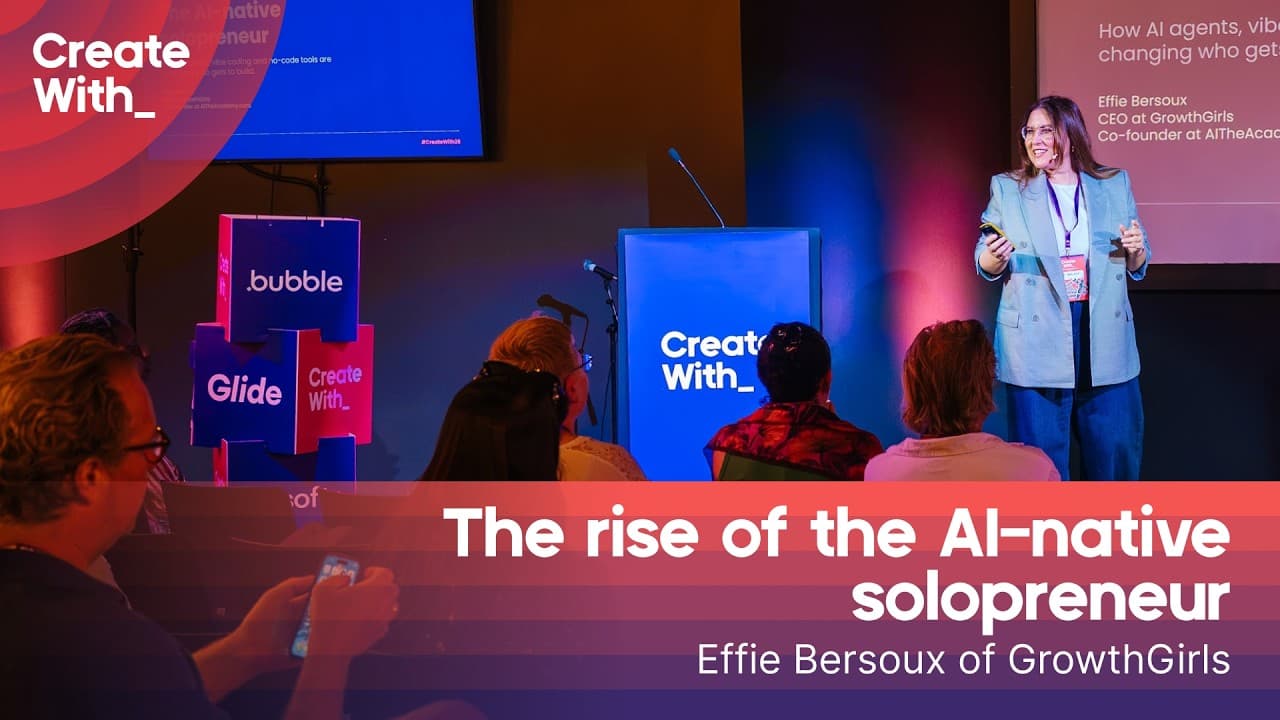
The AI-Native Solopreneur: Build Without a Technical Co-Founder

Effie Bersoux presents a paradigm shift in entrepreneurship where AI enables solo founders to build, validate, and scale businesses without technical co-founders or significant capital. Drawing from Growth Girls' experience building 40+ companies in one year and going from a £4m exit (7 years) to a £40m acquisition target (1 year), she demonstrates how AI breaks the traditional capital-talent-traction loop that disadvantages undercapitalized founders. The talk provides concrete frameworks for AI-native operating models, automation decision-making, and rapid idea-to-market validation.

Watch now ↗
41 min

Meetup

The Mindset Shift That's Creating AI Native Companies

Former HMRC Deputy IT Director Ashraf Murtada shares a framework for understanding AI maturity through three levels: AI Assistance (demanding specific outputs), AI Agents (autonomous systems like Team Brain that join meetings and generate documentation), and AI Coding (building complete applications in hours instead of months). The presentation includes live demos of games, internal tools, and SaaS products built rapidly with AI, arguing that software development is becoming commoditized and traditional MVP timelines are collapsing from 6 months to 6 weeks.

Watch now ↗
28 min

Podcast

51. Running OpenClaw on a $5 server... is it ready for prime time?

James and Kieran from Create With explore the practical applications of Claude Code and OpenClaw in early 2025, demonstrating real-world deployments including running AI agents on budget servers, replacing traditional automation tools with AI-powered workflows, and showcasing Bubble's new in-app payment features. The discussion covers hands-on experiences with deploying production websites, managing email campaigns with AI, and building personal AI operating systems.

Watch now ↗

Latest tool news

What else changed this week.

All tool news
GeminiRoundup

Gemini 4 Argon Reaches Builder Platforms

Gemini 4 Argon is moving straight into the platforms where builders write code, automate work and create prototypes. This week, Vercel, n8n, Netlify and Figma each added access to…

The Create With Briefing

Don't watch forty changelogs. Read one email.

Every Tuesday: the tool changes worth knowing, real business use cases, and what's on near you. Free, unsubscribe any time.