 Adalo
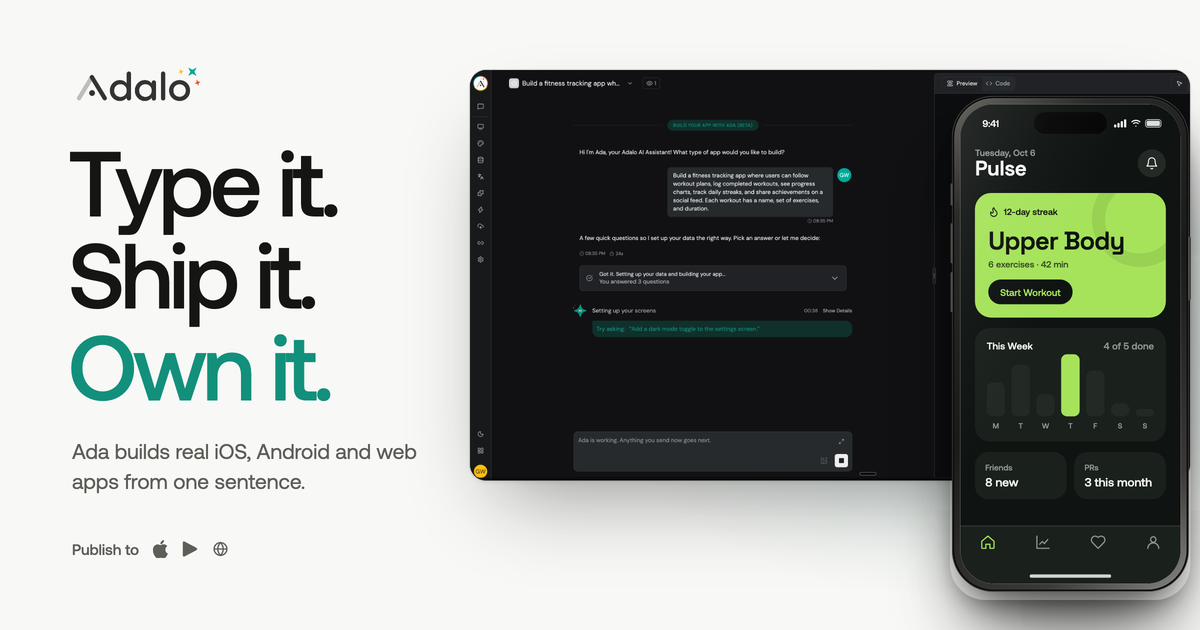
Two requests kept coming back: build apps that scale and run faster, and make the whole process simpler.
Adalo's answer is Ada by Adalo, an AI-powered builder that turns a short description into a working application. Not a wireframe or a list of suggested components, the real thing. Screens, sign-in flow, and a database structured around whatever you describe.
The launch sits on top of a complete infrastructure rebuild. Adalo says apps now run faster and more reliably. Combine that with Ada, and you get production-grade iOS, Android, and responsive web apps from a few lines of plain English.
Source: Read the official announcement.
What Ada Builds From a Single Description
The old way of starting an Adalo app meant dragging components onto a blank canvas and wiring up data collections yourself. Ada skips that entirely.
Describe your app in a sentence or two. Ada generates every screen, sets up user authentication, and creates a database with the right fields for your idea. A landscaping business app, a garage management tool, or a bourbon price tracker that started as a spreadsheet, all begin the same way.
- 1
Describe your app
write a short description in plain English
- 2
Ada builds
generates all screens, authentication, and a database
- 3
Review and refine
tweak the design or logic in the Adalo editor
- 4
Connect payments
add Stripe or another gateway in a few steps
- 5
Publish
use the Publishing Studio to prepare for the App Store and Google Play
[FILTERED] not locked out of the editor. Once Ada hands you the starting point, you can customise everything the same way you would in a manually built Adalo app. That matters when the first version works, but the second needs specific logic the description did not cover.
Built on Faster, More Reliable Infrastructure
Ada is not just a new creation layer. Adalo rebuilt the infrastructure underneath to make apps faster and more dependable. The company describes the result as production-grade, which means an app built with Ada is not a prototype that needs to be thrown away. It can go live and stay live.
For anyone who has waited through a slow Adalo build in the past, the rewritten backend might be as significant as the AI generation. Both changes arrive together, so the first app you build with Ada also runs on the new foundation.
From Idea to App Store: Payments, Publishing, and Code Export
Building an app is one thing. Shipping it to users is another. Ada connects payments in a few steps, and the Publishing Studio gets apps ready for submission to Apple's App Store and Google Play.
Adalo already invested in the Publishing Studio for manually built apps, as we covered when Adalo launched Publishing Studio to streamline app store submissions. With Ada, that workflow becomes a built-in final step rather than a separate process.
Then there is the code export. Ada-generated apps come with code export, which means the project does not have to stay on Adalo forever. If you outgrow the platform, you can take the code and go. That turns Ada from a rapid-start tool into a genuine launchpad for businesses that might later invest in custom development.
Frequently asked questions
What is Ada by Adalo? Ada is a new AI-powered builder inside Adalo that creates an entire app, screens, user authentication, and a database, from a short text description of what you want the app to do.
Is Ada by Adalo free? The announcement does not include pricing or plan details for Ada.
How does Ada compare with building an app manually in Adalo? Manual building starts with a blank canvas and requires you to drag in every screen, component, and data collection. Ada generates the full starting structure from a plain-English description, so you begin with a working app rather than an empty editor.
Can I export the code from an Ada-built app? Yes. Code export is included, so the app you build with Ada does not have to stay on Adalo. You can take the source code and continue developing it elsewhere if needed.
Sources
4 checkedHow we cover tool news: Create With's tool desk drafts these reports with AI from the sources listed above and checks them against those sources before publishing.

 Stripe
 Airtable

 Squarespace
 ElevenLabs
 ChatGPT