Skip to content
Conference

Everyone Can Build with AI. What Should Companies Do Next?

Create With29:0754 views

Summary

A leadership panel from Create With conference exploring how companies should approach AI adoption when building tools becomes accessible to everyone. Four experts debate the gap between technical capability and strategic judgment, discussing governance frameworks, safe experimentation, product sense development, and organizational learning pathways for AI transformation.

What You'll Learn

The New Bottleneck in AI Development

When technical barriers to building software collapse, a paradox emerges: companies gain the power to create anything but often lack the judgment to decide what they should create. This tension formed the core of a leadership panel at Create With conference, where four experts with diverse backgrounds tackled the strategic challenges of AI adoption.

The panel brought together JJ Englert from Tenex focusing on AI governance, Isabelle Amazon-Brown working with international development organizations, Oana May who has coached over 1,000 product and engineering leaders since leaving Meta, and Max Haining whose company 100 School helps organizations convert AI access into genuine capability.

The 'Should We' Question Replaces 'Can We'

Isabelle Amazon-Brown reframed the central premise immediately: "The problem is the word 'can' and I would actually replace it with the word 'should'." Her work in the humanitarian sector illuminates this tension sharply. Organizations serving vulnerable populations face pressure to maximize efficiency and stretch limited funding further, yet operate in contexts where the stakes of getting it wrong are dramatically higher than in commercial settings.

The data Oana May presented reinforces this concern. Research from Pendo in 2019 showed that 80% of features built were rarely or never used. With AI democratizing the ability to build, that ratio likely worsens. Recent engineering research reveals that while AI adoption drives massive increases in code production, actual bottom-line business gains remain minimal - not because teams aren't building more, but because they aren't building the right things.

Where Non-Technical Builders Should Start

Max Haining's advice for non-technical people entering the building space strips away the intimidation factor. The word 'build' itself carries different meanings across audiences - from vibe coding that feels daunting to beginners, to simple task automation for those just getting started with AI.

His recommended first step: map out tasks you'll execute today, identify the most annoying one to do without AI, then use tools like Claude to work through building a solution. The scale doesn't matter initially - it might produce simple copy or evolve into a complete system. The goal is practical engagement that builds confidence and capability incrementally.

Developing Product Judgment at Speed

Product sense - the intuition for what's worth building - traditionally develops through years of experience making product decisions and learning from failures. Oana May has systematized this learning into a framework that accelerates judgment development for new builders.

Her approach centers on asking specific questions before writing any code: Who exactly experiences this problem? How important is it to them? Would they wake up in the middle of the night willing to pay significantly to solve it? Is the addressable market large enough? Most new builders, she observes, start too broad without sufficient specificity about the actual problem, the people affected, or the business viability.

The framework forces precision: understanding not just what could be built, but whether it should be built based on genuine user pain, market size, competitive positioning, and strategic fit. Without this disciplined thinking, democratized building tools simply enable faster creation of products nobody wants.

Research Must Precede Production Building

Isabelle Amazon-Brown emphasized that research and validation should precede building in production contexts, though she distinguished this from prototyping for testing and alignment. The enthusiasm of non-traditional builders entering the space is valuable, but fundamental product principles developed over decades still apply - arguably with even higher stakes now.

In her sector, inadequate research before building can have serious consequences for already vulnerable populations. But even in commercial contexts, building without research wastes resources and creates technical debt. The speed at which AI enables creation makes the discipline of research and validation more critical, not less.

The Strategic Value of Prototyping

While production building requires research and validation, the panel recognized distinct value in prototyping even when code won't ship. Prototypes improve organizational alignment, test assumptions quickly, and enable stakeholders to respond to tangible artifacts rather than abstract specifications.

This distinction matters for governance frameworks. Companies shouldn't gate all building behind extensive approval processes, but should differentiate between experimental prototyping that builds capability and organizational learning versus production systems that serve customers and carry operational risk.

Converting Access into Capability

Max Haining's work with 100 School focuses specifically on the gap between having AI tools available and actually using them effectively to change how work gets done. Their flagship program, 15 Days of AI, upskills entire companies to raise baseline proficiency, then helps organizations move beyond isolated usage toward genuine transformation in working methods.

This progression - from access to usage to capability to changed work patterns - provides a framework for measuring AI adoption maturity. Many organizations stall at the 'access' or 'usage' stages without building systematic capability or fundamentally rethinking workflows.

Leadership Modeling and Safe Experimentation

The panel consensus held that leadership behavior shapes AI adoption more than tool availability. Leaders must model experimentation, continuous learning, and intelligent risk-taking rather than simply encouraging it in others.

Creating psychologically safe environments for experimentation within companies requires clear boundaries around acceptable risk, processes for learning from failures, and cultural norms that reward thoughtful experimentation even when initial attempts don't succeed. Without this safety, teams default to cautious behavior that limits learning and capability development.

Governance Without Stifling Innovation

Balancing governance needs with innovation speed presents a persistent challenge. Organizations need frameworks that enable safe experimentation while preventing serious risks - regulatory violations, security breaches, reputational damage, or harm to users.

Effective governance focuses on risk levels and impact rather than blanket restrictions. Low-risk internal experiments might require minimal oversight, while customer-facing applications need robust validation. Clear criteria for risk assessment, appropriate approval processes for different risk levels, and continuous learning loops create governance that enables rather than blocks innovation.

Building a Learning Organization

The shift toward accessible AI building tools fundamentally changes organizational learning requirements. Companies need systematic approaches to developing judgment, product sense, and strategic thinking across broader populations.

This includes formal training programs like those Max Haining runs, but also peer learning, communities of practice, documentation of decisions and outcomes, and explicit frameworks like Oana May's system for evaluating what to build. The goal extends beyond individual capability to organizational capability - shared language, common frameworks, and collective judgment that improves over time.

Practical Next Steps for Leaders

For leaders navigating this transition, the panel's guidance coalesces around several themes: start with clear use cases that address real pain points, invest in developing judgment alongside technical capability, create safe spaces for experimentation with appropriate boundaries, model continuous learning yourself, and remember that building faster only creates value when directed by strategic thinking about what should be built.

The democratization of building tools represents genuine opportunity, but only for organizations that develop the complementary capabilities in research, validation, strategic thinking, and organizational learning. The companies that thrive won't be those that build the most - they'll be those that combine newfound building capability with discipline about building the right things.

Key Learnings

1Product judgment becomes the critical bottleneck when building tools democratize

With AI making technical building accessible to everyone, the constraint shifts from 'can we build this' to 'should we build this.' Research shows 80% of features built in 2019 were rarely used, and without strategic thinking frameworks, AI may worsen this ratio by enabling faster creation of unwanted products.

2Systematic frameworks can accelerate product sense development

Rather than requiring years of experience to develop product judgment, structured question frameworks force specificity about problem definition, user pain intensity, market size, and business viability before any code gets written. These systems help new builders avoid the common trap of building broadly without understanding who cares enough to pay.

3Non-technical builders should start with task-level automation

The most effective entry point involves mapping daily tasks, identifying the most annoying manual process, and using AI to build a solution - whether that produces simple output or evolves into a complete system. This practical approach builds confidence and capability incrementally without overwhelming beginners.

Learn more about Claude

4Research and validation must precede production building, but prototyping has distinct value

Production systems serving customers require thorough research and validation before building, applying decades of product management principles with even higher stakes. However, prototyping for alignment, assumption testing, and organizational learning carries separate value even when code never ships, and shouldn't face the same governance gates.

5Converting AI access into organizational capability requires structured progression

Effective AI adoption moves through stages: from tool access to actual usage to individual capability to fundamentally changed work patterns. Many organizations stall at early stages without building systematic capability or rethinking workflows, requiring intentional programs that raise baseline proficiency across the company.

6Leadership behavior shapes AI adoption more than tool availability

Creating environments for safe experimentation requires leaders to model continuous learning, intelligent risk-taking, and thoughtful failure analysis rather than simply encouraging these behaviors. Clear risk boundaries, appropriate governance for different impact levels, and cultural norms rewarding smart experiments enable innovation without blocking progress.

Resources Mentioned

Create With Conference Official Site

The annual AI Builder conference in Brighton bringing together founders, operators and makers building with AI, featuring talks and workshops on practical AI development and adoption strategies.

Visit

Claude by Anthropic

The AI assistant referenced in the panel discussion as a tool for non-technical builders to start experimenting with building solutions to automate annoying daily tasks.

Visit

100 School - AI Training Programs

Max Haining's company specializing in converting organizational AI access into usage and capability through their flagship 15 Days of AI program for upskilling entire companies.

Visit

MOATCRAFT by Oana May

Startup teaching systematic frameworks for product judgment and decision-making about what's worth building, founded by former Meta product leader who has coached over 1,000 product and engineering leaders.

Visit

JJ Englert - AI Governance and Transformation

Resources on AI governance, transformation strategy, and organizational adoption from Tenex AI Trainer and panel moderator specializing in helping companies navigate AI implementation.

Visit

Isabelle Amazon-Brown Consulting

Independent consultant specializing in AI product design and advisory for international development and humanitarian sector organizations, focusing on responsible AI adoption in high-stakes contexts.

Visit

Frequently Asked Questions

What's the difference between 'everyone can build' and 'everyone should build' with AI?

While AI tools now make building technically accessible to non-developers, the ability to build doesn't automatically confer the judgment to decide what's worth building. Historical data shows 80% of features built were rarely or never used even before AI democratization. The critical skill becomes strategic thinking about user needs, market viability, and business value rather than technical construction capability. Organizations must develop systematic frameworks for evaluating 'should we' before unleashing 'can we' across teams.

How should non-technical employees start building with AI?

Begin by mapping your daily tasks and identifying the most annoying manual process you currently handle without AI. Then use tools like Claude to work through building a solution, whether that produces simple copy assistance or evolves into a more complex system. The key is practical engagement that builds confidence incrementally rather than attempting ambitious projects immediately. Start with automation that solves your own pain points before expanding to broader organizational or customer-facing applications.

What governance approach balances AI innovation with organizational safety?

Effective governance differentiates risk levels rather than applying blanket restrictions. Low-risk internal experiments for learning and capability building should require minimal oversight, while customer-facing applications need robust validation and approval processes. Clear criteria for risk assessment, appropriate gates for different impact levels, and documented learning from both successes and failures create frameworks that enable innovation rather than blocking it. Leaders must model safe experimentation while establishing boundaries around acceptable risk.

How do you develop product judgment quickly for people new to building?

Systematic question frameworks can accelerate judgment development that traditionally required years of experience. Before building anything, force specificity by answering: Who exactly experiences this problem? How important is it to them - would they wake up at night willing to pay significantly to solve it? Is the addressable market large enough? What makes this competitively defensible? These structured frameworks prevent the common mistake of building broadly without understanding who cares enough to adopt and pay for the solution.

Why do companies struggle to convert AI access into business value?

Recent engineering research shows massive increases in AI adoption and code production, but minimal bottom-line gains because teams build more without building the right things. The progression from tool access to organizational value requires moving through stages: access to usage to individual capability to fundamentally changed work patterns. Most organizations stall at early stages without systematic capability building, peer learning communities, shared frameworks for decision-making, or cultural shifts that reward strategic thinking about what to build rather than building volume.

More content like this

Never miss a video

Get weekly updates on the best AI tutorials, conference recordings, and community content.

Keep Watching

Related Videos

View all videos
55. We're Back! Conference Recap, Running Events with AI & Self-Healing Apps
Podcast35:53

55. We're Back! Conference Recap, Running Events with AI & Self-Healing Apps

James and Kieran return to the Create With Podcast after their summer break to recap the 2026 Create With Conference in Brighton. They discuss how 550 attendees experienced workshops, a charity hackathon where functional apps were built in 30 minutes, and an innovative conference operating system built entirely with AI. The episode covers the latest developments in AI development tools including Anthropic's Fable model, scheduled tasks in Codex, and self-healing applications using PostHog.

The Biggest AI Opportunities for Non-Technical Builders in 2026
Conference38:09

The Biggest AI Opportunities for Non-Technical Builders in 2026

A closing panel discussion from Create With featuring leaders from Glide, Softr, Bubble, Momen, and TechFoundHer examining how AI and no-code platforms are democratizing software development. The panelists explore what non-technical builders can now create, how AI is transforming service businesses, and where expertise still matters when prototypes become production applications.

How to Get Your Product Recommended by Google and ChatGPT
Conference30:12

How to Get Your Product Recommended by Google and ChatGPT

Tanya Van Gastel presents the APEX framework for making products discoverable in AI-powered search engines like ChatGPT and Google's AI Overviews. She explains how AI is fundamentally changing product discovery and buyer behavior, then breaks down five critical components: Authority (being cited as a solution), Presence (visibility across search platforms), Expertise (creating high-quality money pages), Endorsements (off-site validation), and Extractability (making content easy for AI to process). The talk emphasizes quality over quantity, with data showing 50% of SaaS SEO revenue comes from fewer than 10 high-performing pages.

Inside a 60-Skill Claude Code System Running AI Agents in Parallel
Conference35:21

Inside a 60-Skill Claude Code System Running AI Agents in Parallel

Stephany Oliveros, CEO of Lyra AI, presents a production-ready Claude Code architecture for running dozens of AI agents in parallel. She demonstrates a 60-skill system built on progressive disclosure, layered memory, and reusable components that enable coordinated multi-agent workflows without burning through tokens. The talk covers practical folder structures, guardrails, and token economics for building scalable agentic systems.

The AI-Native Solopreneur: Build Without a Technical Co-Founder
Conference34:21

The AI-Native Solopreneur: Build Without a Technical Co-Founder

Effie Bersoux presents a paradigm shift in entrepreneurship where AI enables solo founders to build, validate, and scale businesses without technical co-founders or significant capital. Drawing from Growth Girls' experience building 40+ companies in one year and going from a £4m exit (7 years) to a £40m acquisition target (1 year), she demonstrates how AI breaks the traditional capital-talent-traction loop that disadvantages undercapitalized founders. The talk provides concrete frameworks for AI-native operating models, automation decision-making, and rapid idea-to-market validation.

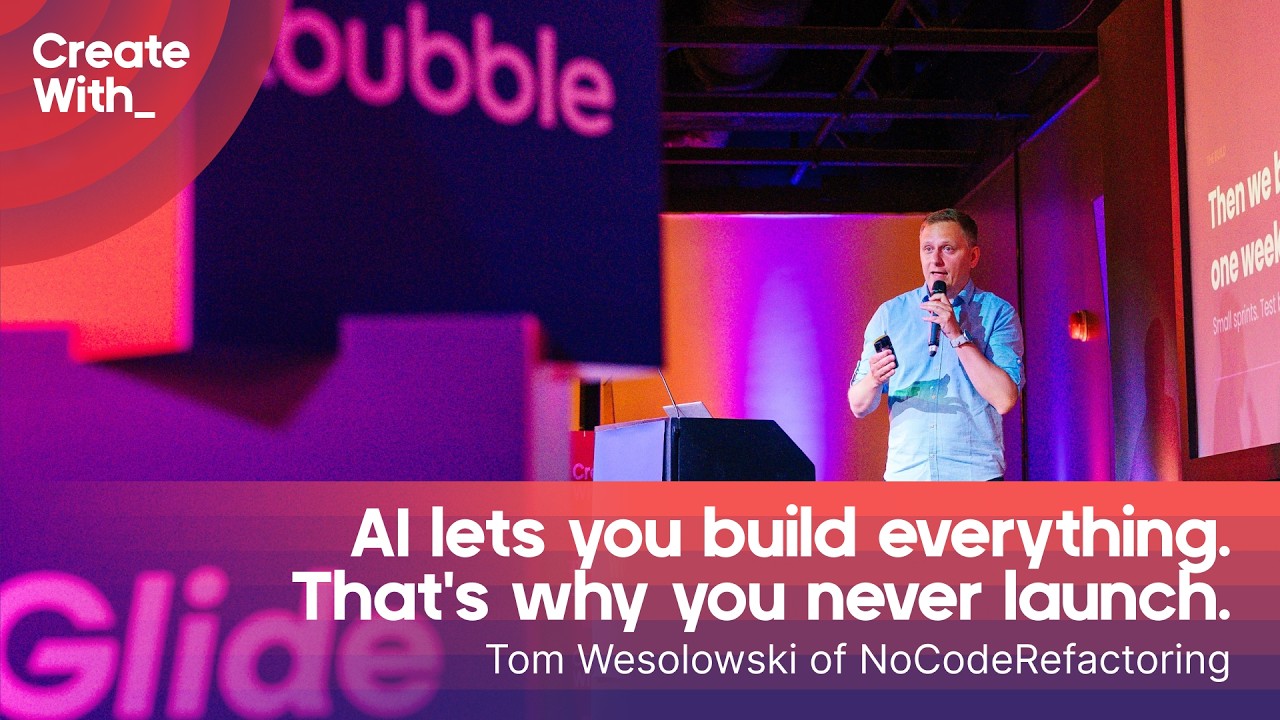
AI Lets You Build Everything—Here’s Why You Still Never Launch
Conference28:15

AI Lets You Build Everything—Here’s Why You Still Never Launch

Tom Wesolowski, owner of NoCodeRefactoring.com, delivers a conference talk exposing how AI's ability to build anything has created a new problem: chronic overbuilding that prevents launches. Using a real marketplace project as a case study, he demonstrates how an 80% scope reduction transformed a stalled four-month development into a revenue-generating product launched in two weeks. The talk provides a practical framework for identifying the minimal viable customer loop and postponing everything else until real user demand validates the need.