 Vercel
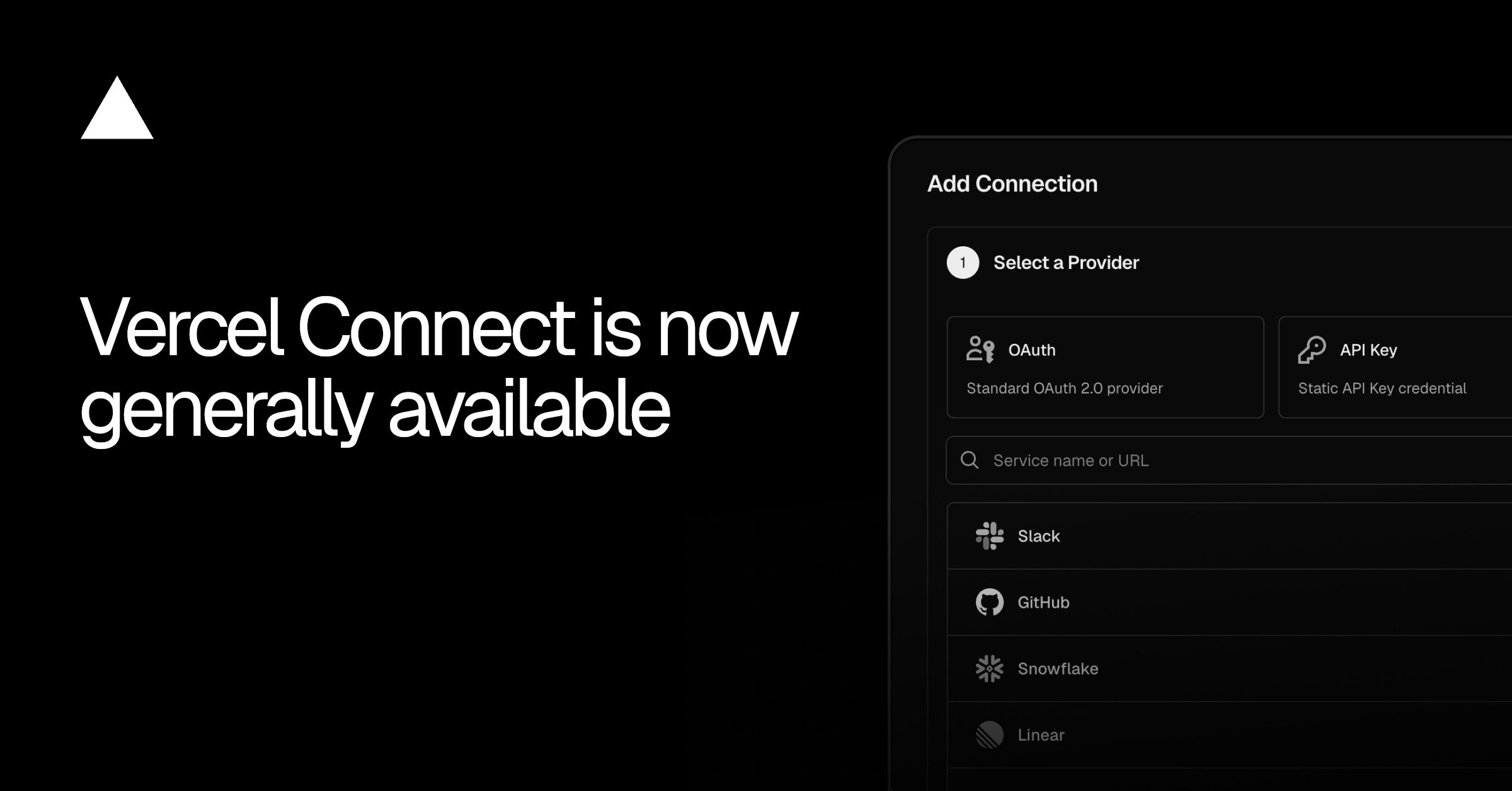
Vercel Connect is now generally available, giving teams a centralized way to connect applications and AI agents with more than 100 external services without relying on long-lived provider credentials. The feature is available across every Vercel plan and inside v0, according to the company’s August 25 announcement.
The release targets a familiar infrastructure problem. Applications that interact with third-party services commonly store API keys or other persistent credentials as environment variables. Those credentials must be issued, distributed, rotated, and revoked, creating additional operational work and increasing the potential impact if a secret is exposed.
Vercel Connect replaces that model with short-lived, scoped tokens requested at runtime. Deployments authenticate using their existing Vercel OpenID Connect, or OIDC, identity. The service then issues a token limited to the relevant task, refreshes it automatically when required, and allows it to expire without developers manually rotating the credential.
A Different Approach to Integration Credentials
The central change is not simply a larger catalog of integrations. It is where credential management happens and how much access each deployment receives.
With Vercel Connect, the process works around three security properties:
- Short-lived access: Tokens expire automatically rather than remaining valid indefinitely.
- Scoped permissions: Each token is restricted to the task for which it was requested.
- Deployment identity: Applications authenticate through their existing Vercel OIDC identity instead of embedding a permanent provider secret.
For smaller development teams, that could reduce the amount of bespoke authentication plumbing required when connecting a project to an outside platform. It also narrows the useful lifetime of a leaked token. Vercel still does not remove the need to make careful authorization decisions, monitor integrations, or protect application code, but it changes the default away from broadly reusable credentials.
The feature supports connections to more than 100 services, positioning it as shared infrastructure for both conventional web applications and AI agents. That distinction matters because agents may call several tools during a single workflow, potentially multiplying the number of credentials a team needs to provision and maintain.
General availability also follows continued expansion of the service catalog, including Vercel Connect’s addition of Linq messaging for apps and agents. The company describes Connect as a secure connectivity layer rather than a workflow builder, so developers should still expect to write or generate the application logic that determines when and how an external service is used.
What Builders Should Evaluate
For teams already deploying on Vercel, the most immediate question is whether existing direct API credentials can be replaced with Connect-issued tokens. Projects with several third-party integrations stand to gain more from centralized, automatically expiring access than a simple site using one narrowly scoped API key.
AI applications are another clear use case. An agent that communicates with messaging, data, or productivity services can request task-specific access at runtime rather than holding a collection of durable secrets. That complements Vercel’s broader effort to provide infrastructure for agentic software, including the Run SDK for isolating untrusted code from AI agents.
Availability on all plans lowers the barrier to testing the model in a smaller project before adopting it more widely. It is also available within v0, with implementation details provided in the Vercel Connect documentation. Vercel’s announcement does not identify separate Connect pricing or plan-specific quotas, so teams should verify any applicable usage limits before moving production integrations.
Frequently asked questions
What is Vercel Connect?
Vercel Connect is a connectivity layer for Vercel applications and AI agents. It lets deployed code request short-lived, task-scoped tokens for external services at runtime instead of storing long-lived provider credentials.
Which Vercel plans include Vercel Connect?
Vercel says Connect is generally available on all plans. The announcement does not specify separate pricing, quotas, or usage charges for the feature.
How does Vercel Connect differ from storing API keys?
Stored API keys are often persistent and require teams to manage their distribution and rotation. Vercel Connect authenticates deployments through their existing OIDC identity, issues scoped tokens, refreshes them automatically, and lets them expire on their own.
Sources
1 checkedHow we cover tool news: Create With's tool desk drafts these reports with AI from the sources listed above and checks them against those sources before publishing.






 ElevenLabs

 Glide

 Stripe