 Claude
 Supabase
For everyone who was there, everyone who missed it, and every speaker who made it what it was — here's Shayne Cuffy's recap of CreateWith Conference 2026. This piece was originally published on LinkedIn and is republished here with his blessing.
Building is no longer the hard part. The real skill has moved to judgement: knowing what to build, what to leave out, how to make it real, and how to get it into the world.
That is the thread I want to pull through the whole day, speaker by speaker.
01 / 09
Part one: anyone can build now
It started where it should, with the two people who built the room.
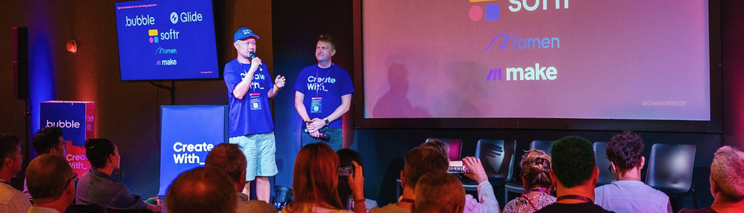
"Software used to be built by the few for the many. Now the person who feels the problem can build the fix."
— Kieran & James
Two former spreadsheet jockeys and product managers who got tired of having ideas they could not build. The whole conference runs on AI, and the two of them, in their spare time — which is the point made flesh.
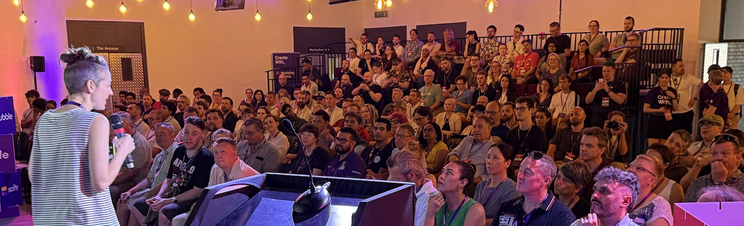
"Go to the talks, learn everything, but say hi to the person next to you — because the people part is what lasts."
— Kelly Claus
She was right. (More on that at the end.)
JJ Englert — AI trainer at Tenex
JJ gave one of the most inspiring origin stories of the day: a filmmaker, a non-technical founder, told a feature would cost $50,000, who almost quit more than once. Then he learned to build, and it changed everything.
This is not magic; it is reps. If someone like him can do it, so can you. Get your reps in!
He is now touring with Anthropic, teaching small business owners Claude Code and Cowork.
Effie Bersoux — founder of GrowthGirls
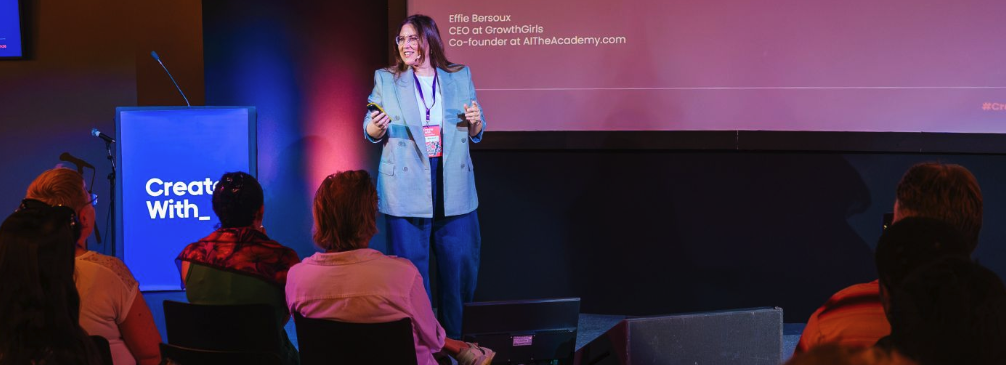
"The next unicorn founder will not have a technical co-founder."
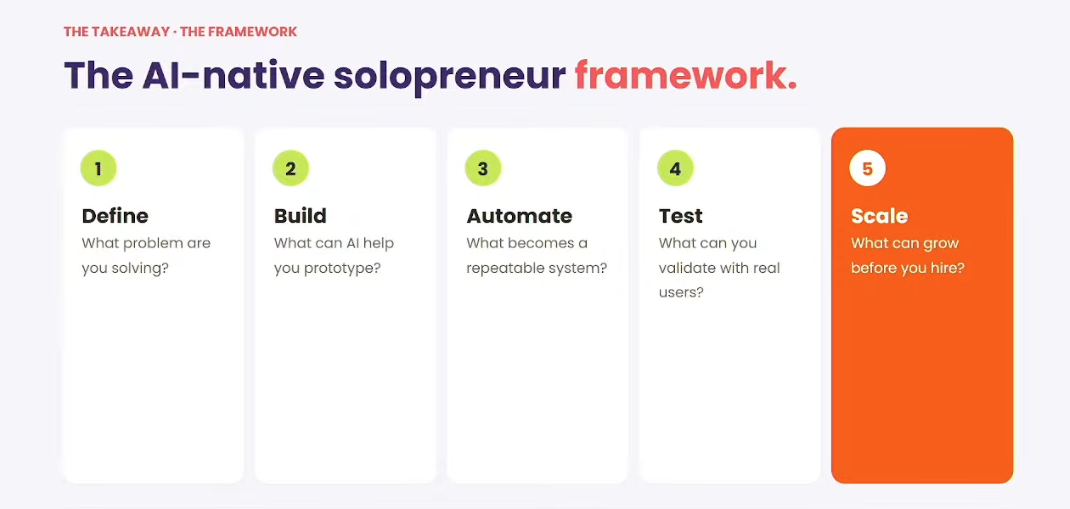
Effie made democratisation real with numbers: she sold one startup built over seven years, then built the next in a single year without a technical co-founder. Her talk was about the access gap closing — the founders who never had capital, network or tech talent can now build fast and show real traction instead of just pitching. The AI-native solopreneur is not a founder who works alone; it is a founder whose first team consists of agents.
02 / 09
Part two: so the real skill is knowing what not to build
If everyone can build anything, then effort is no longer the bottleneck. It is taste. This was the heart of the day for me.
Tom Wesolowski — founder of NoCodeRefactoring
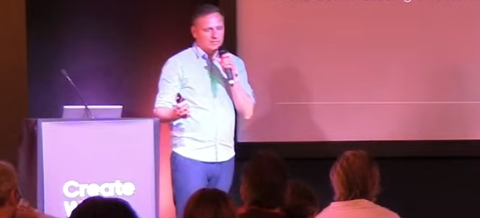
"Today's skill is not building faster. It's building less."
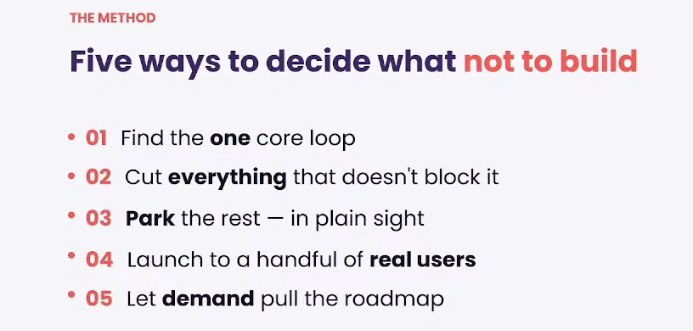
Tom told the story of a marketplace that spent four months building and could not launch — because it was built for 10,000 users before it had 10. His one question: if cutting this feature breaks the core loop, keep it; if not, cut it. He cut 80% of the scope, and they were earning money in two weeks. His rule stuck with me: if you cannot launch in three or four weeks, you have overengineered it.
Oana F. May — founder of MOATCRAFT, ex-Meta
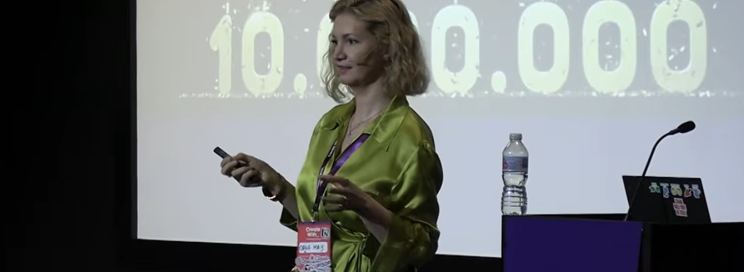
"Good product judgement isn't having ideas. It's knowing which ones deserve to be built."
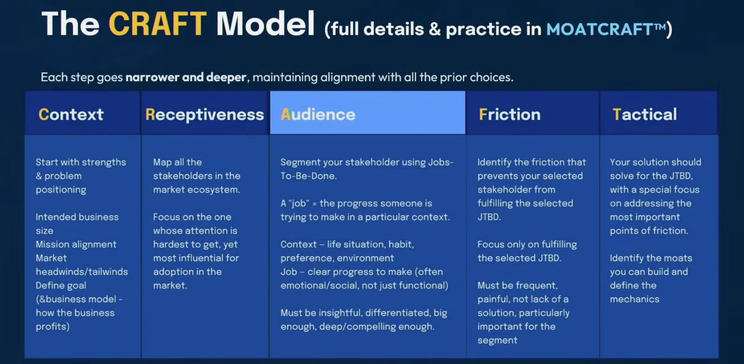
Oana ran a brilliant exercise: here is ten million pounds — build a maps app. Almost everyone reached for a version of Google Maps, which is functional fixedness, and she noted that the smarter you are, the harder you cling to the first solution. She shared the stat that in 2019, 80% of features built were rarely or never used, then asked us to imagine that number now. Her CRAFT model is a funnel for reaching the right thing before you write a line of code.
03 / 09
If everyone can build — now what
The panel brought together JJ, Oana, Isabelle and Max from 100 School, to dig into what happens once building is no longer the bottleneck.
"Replace 'can' with 'should'."
JJ opened with the real question beneath the hype: not whether everyone can build, but whether they should, and what happens inside a company once they do. Oana brought her product judgement lens in hard, warning that democratised building without judgement means more things nobody asked for. Max grounded it in practice — what it actually takes to train non-builders inside a company to use these tools well, not just have access to them. And Isabelle landed the line of the panel.

04 / 09
Part three: and how to make it real
Knowing what to build is half of it. The production crew spent the day on the other half: software that is trusted, adopted, and actually works.
Stephany Oliveros — CEO of Lyra AI
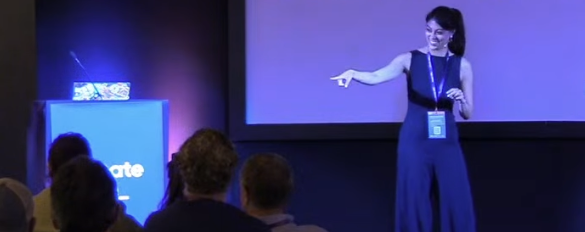
"Stop thinking about prompts. Start thinking about architecture."
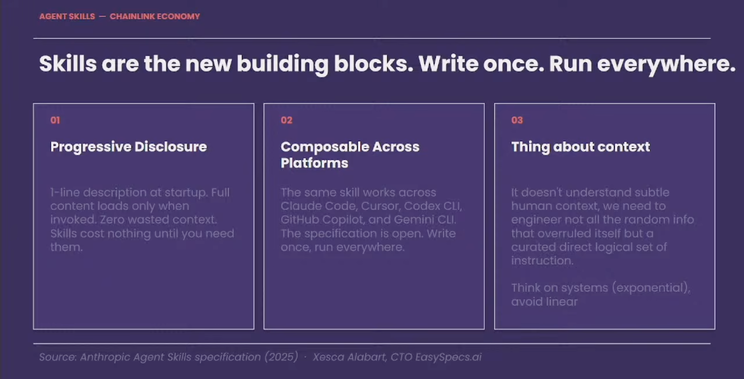
The most technical talk of the day, and one of the most fun. Stephany walked through her harness live: progressive disclosure, a three-layer memory system, a swarm of agents, and the discipline that took her from 15K tokens a session to 8K — a 42% saving, with her whole team on a single Claude Max account. Her framing of compound engineering versus dark factories is the most useful mental model I took home.
Mariam Hakobyan — co-founder & CEO, Softr
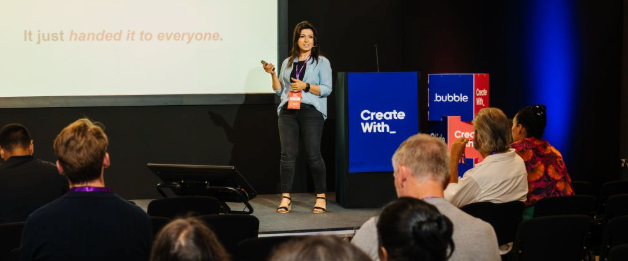
"AI didn't remove the complexity of software. It just handed it to everyone."
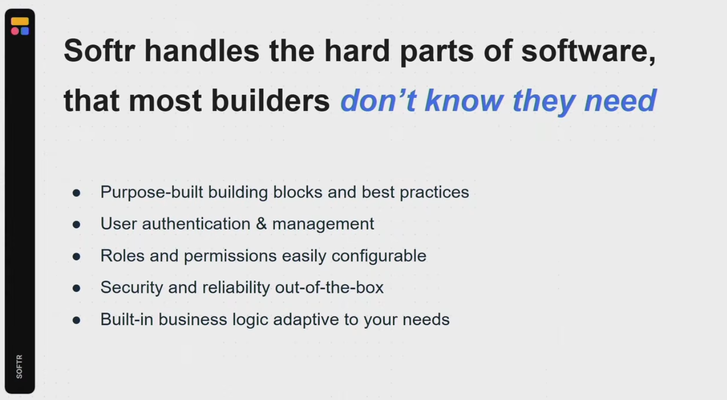
Mariam's line was the sentence of the day for me. The shiny UI is only 10% of a real business app. The other 90% is the databases, the login, the roles, the permissions, the security — the hard part a prompt does not solve, it just exposes. Her answer is the best of both worlds: AI for the personalisation, proven no-code rails for the parts you cannot afford to get wrong.
Raj Navakoti — staff software engineer, IKEA
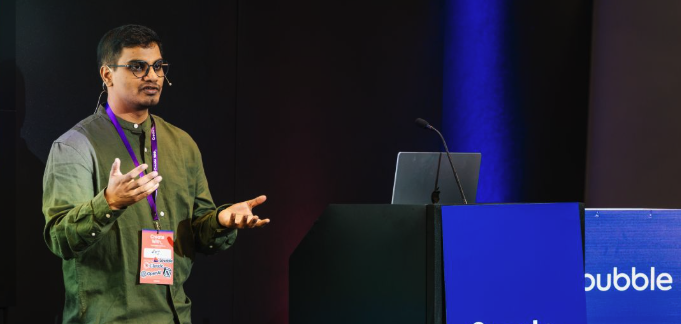
"The problem isn't that the models are dumb. It's that they don't know your world."
Raj nailed why AI so often fails on company-specific questions: there are two worlds — the model's training data and your actual business — and they do not meet. He found that 40% of business knowledge was never written down, and of what is written, only a fifth is clean. His demand-driven approach scopes the context to what an agent actually needs, then extracts, structures and fills the gaps — turning 148 messy documents into a queryable company brain for under a dollar.
David Siegel & Andy Claremont — Glide, with Incredible
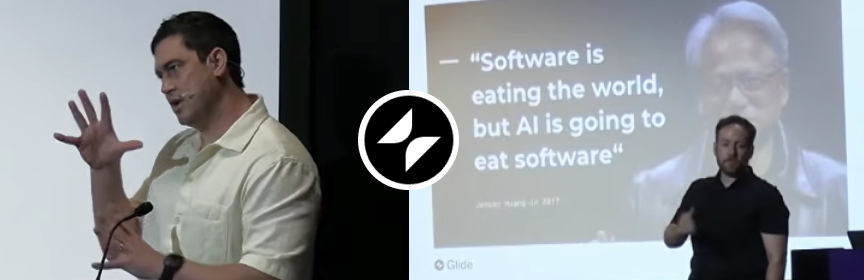
"Building software is not the challenge anymore. Getting it adopted is."
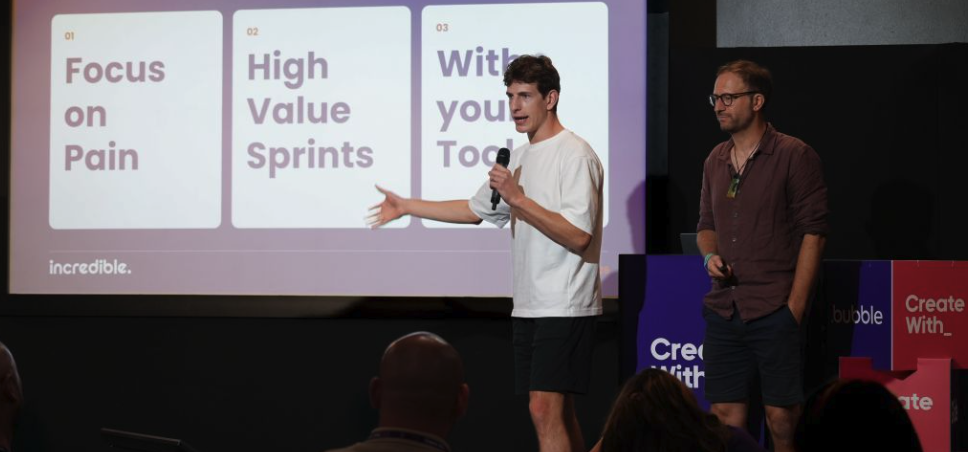
David, with Andy Claremont and the team from Incredible, made the adoption point with hard data: software shipped is through the roof, software actually used is flat. Their answer is to start from where businesses already are — the humble spreadsheet — treat it as a super prompt, and never add friction. Glide's whole pitch is making the invisible, critical parts of software visible so you can trust them. Incredible's three-word version was just as good: focus on pain.
05 / 09
Part four: then get found, and build it your way
You can build the right thing, and build it well, and still nobody finds it. Two talks closed that gap.
Tanya Van Gastel — founder of RankingOnAI
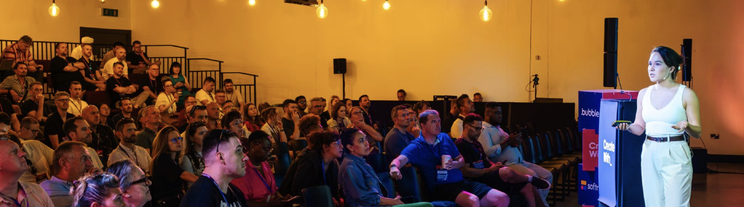
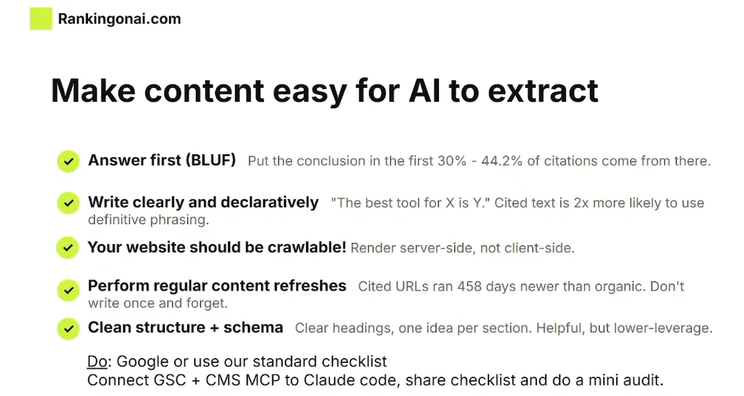
Tanya made being discovered feel learnable. Her APEX framework — Authority, Presence, Endorsements, Extractability — is how you become the answer when someone asks Claude or ChatGPT or Google for a solution like yours. Her most freeing point:
SEO is not the dark art people think it is — it is genuinely helpful content. The flood of spammy AI content has made real writing more competitive, not less. Good AEO is good SEO.
Marie Martens — co-founder of Tally
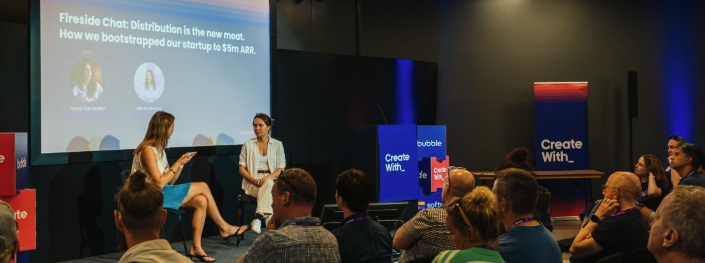
"We just wanted to do one thing really well."
In a fireside with Tanya, Marie told the bootstrapper's dream story: Tally — two million users, a team of ten, around five million ARR, no VC, no ads. Three things did it: a genuinely generous free tier, where the "made with Tally" badge turns every form into distribution; ruthless simplicity; and being themselves, bootstrapped and building in public. Her line on the AI fear was telling — tools like Lovable now send people to Tally rather than replacing it, because nobody wants to vibe code a contact form.
06 / 09
Frameworks worth stealing
If you want the day as a toolkit, here it is in one place. Each of these came from someone above — so go and learn it from the person who built it.
- Get your reps in — JJ Englert: build, throw it away, build again. Volume beats theory.
- The cut test — Tom Wesolowski: if removing a feature breaks the core loop, keep it. If not, cut it.
- CRAFT — Oana May: Context, Receptiveness, Audience, Friction, Tactical solution. Decide what to build before you build.
- The harness — Stephany Oliveros: progressive disclosure, a three-layer memory, and a swarm of agents instead of one tired prompt.
- Build on rails — Mariam Hakobyan: AI for the 10% that delights, proven foundations for the 90% that matters.
- The four pillars — Nick Carroll: security, scalable infrastructure, observability, testing. That is what production-ready means.
- Two-way doors — George Collier: make decisions you can reverse, and build for the problems you actually have today.
- Demand-driven context — Raj Navakoti: scope, extract, measure the gaps, fill them. Give the model your world.
- APEX — Tanya Van Gastel: Authority, Presence, Endorsements, Extractability. How to be the answer AI gives.
- The free tier flywheel — Marie Martens: a genuinely useful free product that markets itself.
Screenshot that one. It is the whole conference on a single slide.
07 / 09
Peak moment
I will give the peak to David Siegel, from a tweet he revisited on stage.
"I feel like a supernova of creativity all the time."
— David Siegel
The engineering filter has been removed. The people closest to the problem can finally build the fix. That is a beautiful thing to stand inside.
08 / 09
Three principles to begin with
If you take nothing else from the day, take these.
One. Start from the pain, never the tool.
Every strong talk began with a real problem, not a shiny feature. Find what genuinely annoys you or your customer, and build for that.
Two. Build less, and understand what you build.
The skill now is cutting, not adding. Ship the core loop, leave the rest, and never let an agent build something you could not explain to a new hire.
Three. Begin today, and get your reps in.
You do not need permission, a co-founder, or a computer science degree. Build one small thing this week, then the next. That is the whole journey.
09 / 09
Final thank-yous
To Kieran, James and Kelly for the room. To every speaker who travelled, in that heat, to share what they know. And a real shout to the people who ran the hands-on rooms and the talks I could not fit here in full: Harold Dijkstra and 100 School on the hackathon, Matt Roberts of Happy Operators, Sofiia Matsiutsia and Dan of the Vibe Coding Collective, Sonia Toqqe on automation, Andrew Bryce of Sixty Seconds, and Tanveer on the OpenClaw experiment. Every one of them gave their day so the rest of us could learn.
And finally, Karla Fernandes — for her unmatched generosity with her time. She gave me direction and great advice, and paid for my lovely meal in the sun.
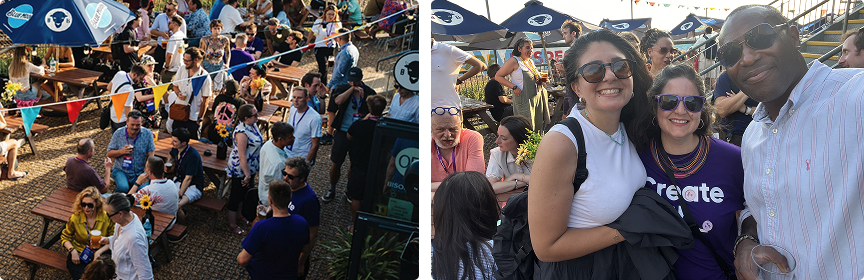
The fastest way to learn this stuff is by doing it together — and the people who share generously are the ones worth building with.

Written by
Kieran Ball
Co-founder, Create With

Written by
James Devonport
Co-founder, Create With
The Create With Briefing
Get the next edition first.
Real-life use cases, the tool changes that matter, and the best events near you. Free, every Tuesday, to 8,600+ readers.