A full-day hackathon for Ruby developers building AI applications. This event is hosted by the SF Bay Area Ruby Meetup and offers a chance to explore how to supercharge your AI development process using the latest tools and techniques. No fees, big prizes, and free lunch are included. All skill levels are welcome to participate in this collaborative coding event. The focus is on moving faster, collaborating better, and prototyping smarter with AI tools.
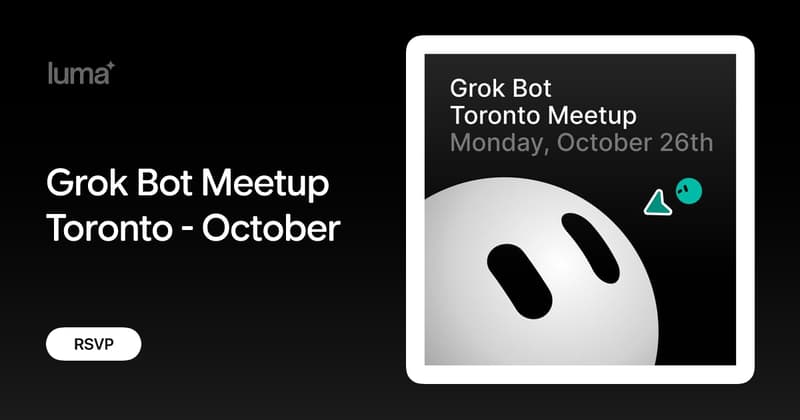
Learn how to automate daily life with Grok Bot at this hands-on Toronto meetup on 26 October 2026, featuring talks, Q&A, building and networking. Taking place from 5:30pm to 8:30pm EDT in Toronto, this monthly community event combines practical AI learning with time to meet other builders and work on ideas. Bring your laptop so you can participate in the building session. Dinner and drinks will be provided, and attendees will also have the chance to receive Cursor credits for use with Grok Bot. Agenda - 5:30pm: Mix and mingle - 6:15pm: First speaker - 6:30pm: Second speaker - 6:45pm: Q&A - 7:00pm: Networking and building - 8:30pm: Event ends The two speakers have not yet been named on the event page. The meetup is hosted by Neerav, Jia and Sukh, with support from a local volunteer team. Important: doors close at 6:15pm sharp. Registration requires host approval, and the exact address is revealed to approved attendees; the organiser describes the venue as 800 Bay. Request to join the meetup
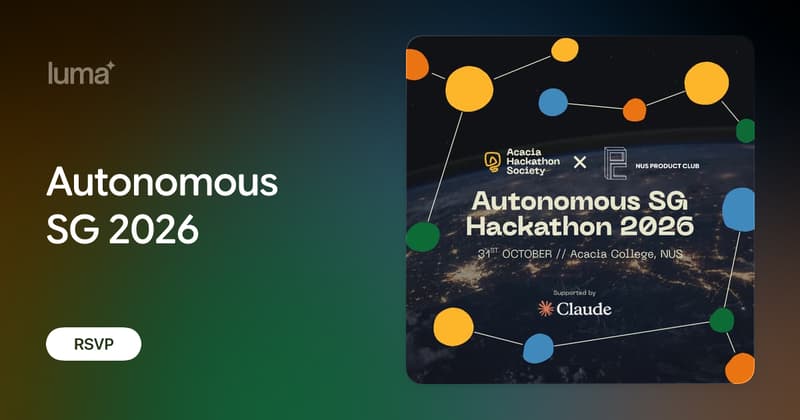
Autonomous SG 2026 is a six-hour AI buildathon for 300+ builders in Singapore, taking place on Saturday, 31 October 2026. Supported by Anthropic, the event challenges participants to build and ship a production-grade AI prototype within six hours. Problem statements will only be revealed on the day, so teams should arrive ready to build rather than prepare a solution in advance. The top five teams will pitch their work live on stage. Who can take part? The buildathon is open to undergraduates, master’s and PhD students, researchers, engineers and working professionals. You can participate solo or in a team of up to four. One person should register for the whole team and request the corresponding number of tickets. Each participant receives: - $50 in Claude API credits - Lunch - Event swag - Access to a community of more than 300 builders Create a free Claude Console account before the event. Credits apply to the Console organisation and are not Claude.ai Pro or Max subscriptions. The event runs 9:00am–6:00pm GMT+8. The exact Singapore venue is shared after registration. Host approval is required, so requesting a place does not guarantee admission. Questions can be directed to Aanya Mathur on LinkedIn. Request to join Autonomous SG 2026
Generative AI Summit brings 500+ engineers and executives to New York on 3 June 2027 to build and scale production-ready AI systems. Designed for people actively building and shipping AI,not simply watching the market,the summit aims to replace months of trial and error with practical insight into what works in production. Organised by AI Accelerator Institute as part of AIAI New York, it focuses on the technical, operational and leadership challenges involved in bringing applied AI products to market. What to expect The programme centres on focused discussions rather than a vast expo hall or marketing-led presentations. Attendees can expect conversations spanning: - Foundational models, LLMs and autonomous systems delivering measurable performance at scale - Generative AI infrastructure, model operations and production tooling - Agent architectures, orchestration and real-world agentic applications - Inference, evaluation and continuous fine-tuning - Live architecture benchmarks and approaches to scaling - Enterprise AI strategy, information security and risk The event is built around learning from peers who are already confronting deployment and scaling challenges. Alongside the content, networking provides opportunities to meet potential partners, innovators and fellow practitioners working on industry-ready AI. Who should attend? This summit is particularly relevant to AI and machine-learning engineers, software engineers, technical architects, model operations and infrastructure teams, product builders, AI leaders and senior executives responsible for enterprise adoption. The material is geared towards practitioners and decision-makers with an active interest in building, deploying or scaling AI systems, rather than a general introductory audience. AIAI New York also brings together co-located summit content covering generative AI, agentic AI and executive AI leadership, with multi-track access promoted by the organiser. This creates a useful meeting point between hands-on builders and the leaders setting strategy, governance and risk priorities.… Register for this event
Learn to build production-ready AI systems in just seven weeks with the AI Engineering Accelerator bootcamp, a hands-on training program that bridges the gap between using AI and building it. Running from June 9 through October 29, 2026, this intensive program combines virtual instruction with a multi-day in-person capstone at the Hyatt Regency Burlingame during ODSC AI West 2026. Designed for professionals ready to move beyond tutorials, the Accelerator provides comprehensive training in the core disciplines of modern AI engineering: large language models (LLMs), agentic AI systems, and production deployment. You'll gain practical experience with the latest tools and frameworks used by leading AI teams, learning not just how to use AI, but how to architect, build, and ship AI-powered applications. Program Structure The bootcamp follows a hybrid learning model that maximizes flexibility while ensuring hands-on engagement. Starting with the Summer Cohort on June 9, you'll participate in virtual training sessions led by experienced AI practitioners. The program culminates in an intensive in-person segment from October 27-29, 2026 at the Hyatt Regency in Burlingame, California, integrated with the main ODSC AI West conference. This dual-format approach allows you to build foundational knowledge remotely while maintaining your current work commitments, then apply those skills in collaborative, hands-on projects during the in-person sessions. You'll also gain full access to ODSC AI West's conference tracks, expo, and networking events. What You'll Learn The curriculum focuses on production-grade AI engineering, covering: - LLM development and deployment — Fine-tuning, prompt engineering, and optimization techniques - Agentic AI systems — Building autonomous agents and workflow automation - AI Engineering fundamentals — MLOps, model serving, monitoring, and scaling - Real-world implementation — Moving from prototype to production with confidence Organized by Open Data Science Conference, which has spent 11 years training thousands of AI engineers and data scientists, the Accelerator draws on ODSC's deep expertise in practical AI education. The program features specialization tracks tailored to different AI engineering domains, allowing you to focus on the areas most relevant to your career goals. Who Should Attend This bootcamp is designed for professionals who already work with AI tools and are rea
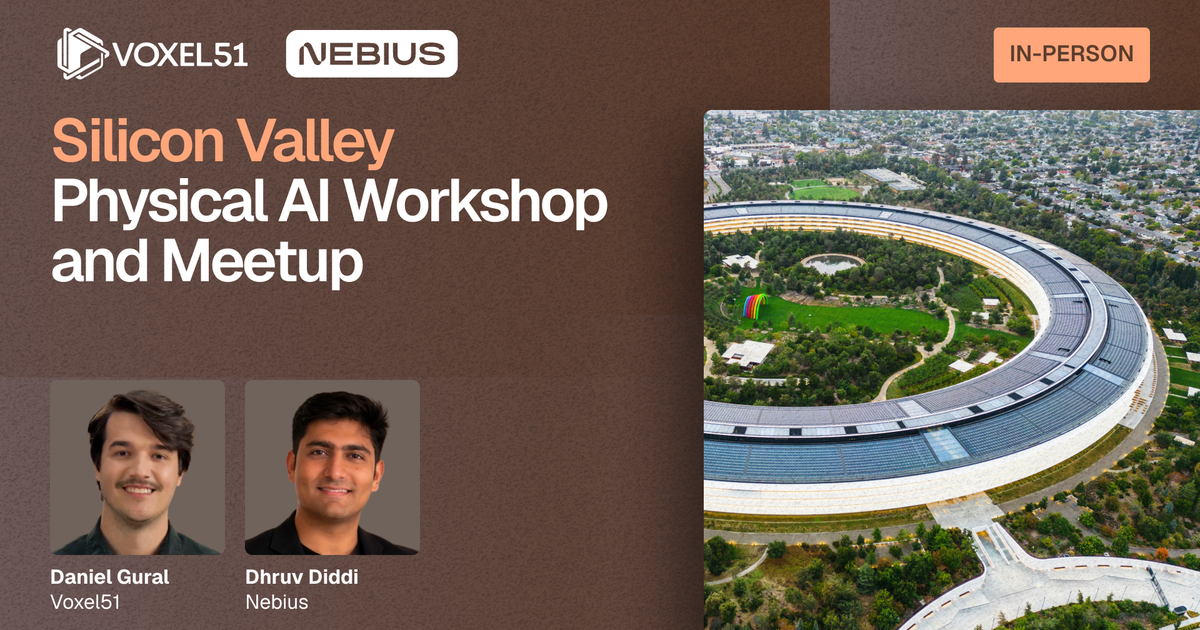
Build an end-to-end physical AI workflow in Menlo Park on 27 October 2026, using real robotics data, FiftyOne and a live fine-tuned YOLO11n detector. Co-presented by Voxel51 and Nebius, this three-hour, in-person meetup combines expert lightning talks, informal networking and a technical workshop at Silicon Valley AI Hub. The focus is practical: turning raw robot logs into curated training data, producing labels, training a computer vision model and reviewing its predictions in the original multimodal recording. What you’ll do The workshop uses DROID, a real-world robotics dataset loaded into FiftyOne as a native multimodal MCAP recording. Attendees will work with synchronised camera feeds, proprioception and language data on one timeline, with no ROS installation required. During the session, you’ll: - Explore a DROID robotics recording in FiftyOne’s multimodal MCAP viewer - Extract and browse frames, then filter and deduplicate the dataset - Compute embeddings and investigate the curated frames through similarity search and embeddings visualisation - Use open-vocabulary detection to auto-label the robot gripper and target objects - Fine-tune a YOLO11n detector on the generated bounding boxes - Evaluate the resulting model and view its predictions on the original MCAP timeline Embeddings and model training will run through Nebius Serverless AI Jobs. The evening closes with a walkthrough of Nebius Token Factory, including chat and vision models, fine-tuning and credits. You can also explore the FiftyOne documentation before attending. Evening format - 5:30–6:30 PM: Networking, food, drinks and lightning talks from local practitioners working across AI, machine learning and computer vision - 6:30–7:30 PM: From raw robot logs to a curated dataset, including multimodal exploration, frame extraction, deduplication and embeddings - 7:30–8:00 PM: Auto-labelling, live YOLO11n fine-tuning and model evaluation - 8:00–8:30 PM: Nebius Token Factory walkthrough This is a technical, hands-on event for people interested in robotics datasets, computer vision, machine learning and physical AI. It offers an opportunity to follow a complete model-development loop while meeting others working in the Silicon Valley AI community. Before you attend… Register for this event
Explore how Physical AI systems turn robotics, sensor and vision data into real-world applications at this practical workshop and meetup in San Francisco. Co-presented by Nebius and Voxel51, this three-hour, in-person event combines short community talks with a hands-on introduction to building Physical AI applications using FiftyOne. It takes place on Wednesday, 28 October 2026, from 5:30pm to 8:30pm PDT at Antler San Francisco, 3rd Floor, 144 Townsend Street. What to expect The evening begins in a meetup format, with lightning talks from local speakers working across artificial intelligence, machine learning and computer vision. These concise sessions offer a look at the ideas and technical challenges shaping Physical AI before the programme moves into a practical workshop. During the hands-on portion, attendees will work with FiftyOne and explore key parts of the Physical AI development workflow, including: - Curating robotics and sensor datasets - Working with visual data captured in real-world environments - Evaluating computer vision models on real-world data - Building Physical AI applications with FiftyOne Bring a laptop if you want to follow along with the workshop. The blend of lightning talks and guided building makes this especially relevant to AI and machine learning practitioners, computer vision specialists, robotics teams, researchers and technical builders interested in data-centric development. No specific experience level is stated, but the workshop’s practical focus will be most useful to attendees who want direct exposure to Physical AI tools and workflows. Workshop access requirements A company, university or government email address is required to access the hands-on workshop environment. Personal or disposable accounts, including Gmail, Yahoo, Outlook and similar services, cannot be used. According to the organisers, this platform-wide policy supports fraud prevention, abuse controls and compliance requirements. Anyone who needs an exception should contact the hosts before attending.… Register for this event